Month 7 · sky guide
The sky in July
July is the month the summer Milky Way finally delivers. Sagittarius and Scorpius reach their highest point, and from a dark site the sky stops looking like scattered stars and starts looking like a structure.
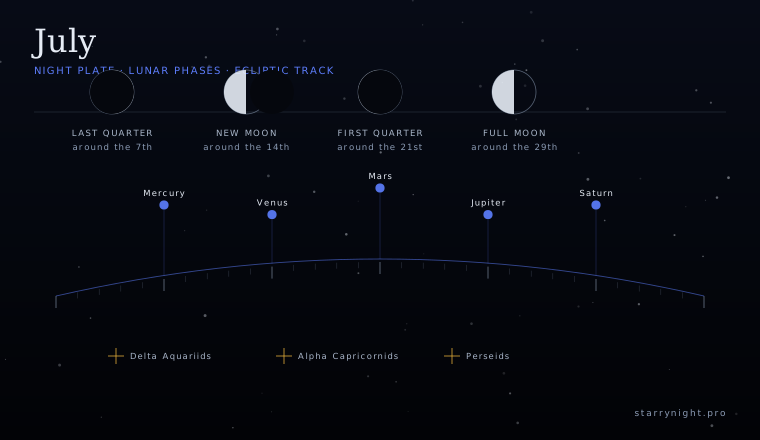
What the month looks like
By midnight the Summer Triangle is close to overhead and the Milky Way runs from Aquila through Cygnus to Cassiopeia in the north-east, splitting around the Great Rift. Further south, the Teapot of Sagittarius sits at its highest and the region around the galactic centre is packed with naked-eye star clouds, dark nebulae and clusters. The Moon is out of the evening sky for roughly the middle ten days of the month, which is when to plan your longest sessions. In the second half of the month the Delta Aquariids and Alpha Capricornids both peak, though the full Moon at the end will mute them.
The month at a glance
July delivers the year's best look at the summer Milky Way. The galactic centre in Sagittarius climbs highest this month, and from a dark site the Great Rift—the dark lane splitting the glowing band—becomes obvious. Around the Teapot asterism, M8, M20, M17 and M22 all sit within a few degrees of one another, a rare concentration of nebulae and clusters. By midnight the Summer Triangle is overhead, with the Milky Way running through Cygnus. The dark window around the 14th, when New Moon leaves the sky moonless, is the prime time for these targets. Earlier in the month, high-latitude observers may still catch noctilucent clouds low in the north during twilight. Whether you chase deep-sky objects or simply lie back and trace the Rift, July rewards patience: the richest part of the sky is also the one that demands the darkest hours.
Planets in detail
Mercury makes a modest evening apparition early in July, low in the west just after sunset. It's a challenging target—small, buried in twilight—so use binoculars and a clear horizon. A small telescope will show a phase that changes as the month wears on. Venus returns as a brilliant evening star in the west, but at northern latitudes it sets soon after the Sun, so look low in bright twilight. Even a small telescope reveals its phase, though the disk is small at first. Mars rises after midnight as a small orange point; it's still not worth high magnification, though a modest scope will show a tiny disk. Jupiter is now a well-placed morning object, rising before midnight by month's end and climbing steadily. A small telescope easily shows its four Galilean moons and two dark equatorial belts. Saturn rises around mid-evening and stays visible most of the night; its rings are the highlight for any small scope, and it's an easy, rewarding target.
Showers and dark windows
The Delta Aquariids peak on the night of 29–30 July, around 20 per hour, but the Full Moon on the 29th will cut that rate noticeably. The Alpha Capricornids peak around 30 July with about 5 per hour, also compromised. The Perseids build all month, reaching a few per hour by the last week, but they too face moonlight. So the best meteor nights are not the peak nights. The Last Quarter on the 7th rises after midnight, leaving the evening dark for early Perseid stragglers. The New Moon on the 14th offers the month's darkest skies, though shower rates are low then. The First Quarter on the 21st sets around midnight, so after that the sky is dark again. For the Delta Aquariids and Alpha Capricornids, the radiants lie in Aquarius and Capricornus, south-east after midnight. By then the Moon is full on the peak night, so plan instead for the pre-dawn hours earlier in the week, when the radiant has climbed but the Moon is less intrusive.
Planning your nights
Start with the early evening: through the first half of July, Mercury sits low in the west after sunset, and noctilucent clouds may still glow in the north. By 22:00, the Sagittarius star clouds are due south, low but rising toward their highest point around midnight. That means the real deep-sky work waits. Use the first week to catch Mercury and noctilucent clouds, then set up for the Milky Way before moonrise. The week of 8–14 centers on the New Moon on the 14th—an all-nighter for M8, M20, M17, M22, and the Great Rift. Mid-month, M13 and M92 in Hercules are high overhead at midnight, perfect for when the Moon is a thin crescent. The week of 15–21 brings First Quarter on the 21st, good for lunar terminator detail, and after midnight the sky darkens. Finally, 22–31: the Full Moon on the 29th ruins the Delta Aquariids, so shift to pre-dawn Venus and Jupiter, low in the east before sunrise.
Lunar phases
- Last quarter around the 7th Moon rises after midnight; the evening sky is dark.
- New Moon around the 14th The best dark window of the month for the summer Milky Way.
- First quarter around the 21st Good lunar terminator detail on the Mare Imbrium shore.
- Full Moon around the 29th Coincides with the Delta Aquariid peak, which will cut the rate noticeably.
Phase dates are approximate and quoted in UTC; confirm against a current almanac before you travel.
Planets this month
- Mercury A modest evening apparition early in the month, low in the west just after sunset.
- Venus Returns as a brilliant evening star in the west, setting soon after the Sun at northern latitudes.
- Mars A small orange point rising after midnight; still not worth high magnification.
- Jupiter Now a well-placed morning object, rising before midnight by the end of the month and climbing steadily.
- Saturn Reaches opposition later in the year; this month it rises around mid-evening and is visible for most of the night.
Meteor showers
-
Delta Aquariids
- Peak
- night of 29–30 July
- Rate
- around 20 per hour
A broad, gentle peak with faint meteors; the radiant is highest in the small hours.
-
Alpha Capricornids
- Peak
- around 30 July
- Rate
- 5 per hour
Low rate but famous for slow, bright fireballs that leave persistent trains.
-
Perseids
- Peak
- building all month
- Rate
- a few per hour by the last week
The main peak is in August, but activity climbs steadily from mid-July.
Highlights
- The galactic centre region in Sagittarius is at its highest — the best month of the year for the summer Milky Way.
- M8, M20, M17 and M22 all fit within a few degrees of one another in the Teapot.
- The Summer Triangle is overhead at midnight, with the Milky Way splitting through Cygnus.
- The Great Rift — the dark lane dividing the Milky Way — is obvious from a dark site.
- Noctilucent clouds are still visible in the north at high latitudes in the first half of the month.
Night-by-night calendar
| Window | Event | Where to look |
|---|---|---|
| All month, after 22:00 | Sagittarius star clouds | Due south, low; highest around midnight |
| Around the 14th | New Moon | Best night of the year for the summer Milky Way |
| Mid-month | M13 and M92 in Hercules | High overhead at midnight |
| 29–30 July | Delta Aquariids and Alpha Capricornids | Radiants in Aquarius and Capricornus, south-east after midnight |
| Late July, pre-dawn | Venus and Jupiter in the morning sky | Low in the east before sunrise |
Field tips
Give your eyes a full 30 minutes to dark-adapt and then do not look at any white light for the rest of the session — even a brief glance resets much of the process. Lie flat on a mat rather than sitting; you will see far more of the sky and your neck will thank you. If you are at a new site, walk the ground in daylight first: tripods and rabbit holes are the two biggest causes of ruined equipment in the dark.
Note
StarryNight is an informational reference for amateur observers. Nothing here is professional astronomical, navigational or safety advice — always check a current almanac and your local weather before travelling to a dark site.
The same guide in the other language: 七月天象