Month 8 · sky guide
The sky in August
August is the Perseid month and, for many observers, the best all-round month of the year: the summer Milky Way is still high, the nights are lengthening again, and the first autumn objects are rising before dawn.
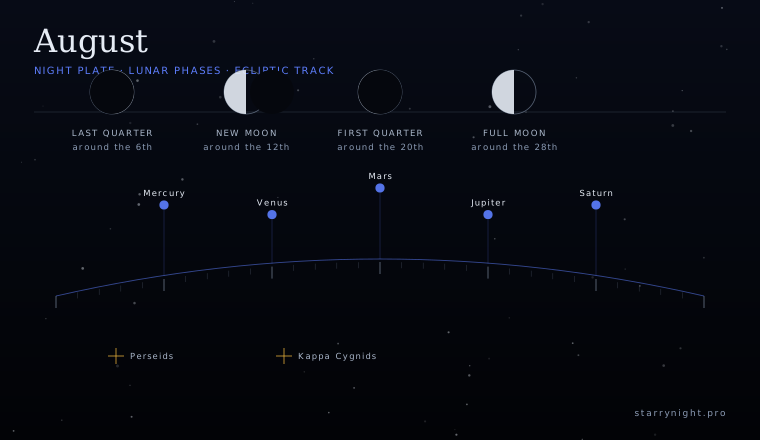
What the month looks like
At dusk the Summer Triangle is overhead and the Milky Way is at its richest through Aquila, Scutum and Sagittarius. As the night goes on, the sky rotates so that by 02:00 the Milky Way stands almost vertical, running from the north-east down to the southern horizon. The Perseids peak on the night of 12–13 August, and this year the peak falls close to new Moon, so rates should be near the maximum the shower can produce. By the end of the month, Andromeda and Pegasus are well up in the east and the first hints of the autumn sky appear.
The month at a glance
August opens with a waning Moon, and by the 6th last quarter leaves the early morning hours dark — exactly the stretch the Perseids need. New Moon arrives around the 12th, landing within a few nights of the shower's peak: the best meteor timing in several years. Before the sky fully darkens, the Sagittarius and Scutum star clouds hold the south for the first hour or two, and the Great Rift through Cygnus is at its most striking on those dark nights before the peak. M13, M92 and the Ring Nebula M57 are all high and easy in the first half of the night, so a small telescope has plenty to do while waiting for meteors. After midnight, the Andromeda Galaxy M31 climbs in the north-east, a sign of autumn. First quarter on the 20th brings the evening Moon and fine terminator detail around the Apennines, and full Moon on the 28th closes a month that rewards both dark-sky and lunar observers.
Planets in detail
Mercury is effectively out of the picture this month: solar conjunction in mid-August keeps it too close to the Sun for any useful observation. Venus is the easy one — very bright, but low in the western twilight, so you need a clear horizon and a little patience as the sky fades. Later in the month a crescent phase begins to show, a pleasing sight in a small telescope if the air is steady. Mars is a morning object, rising around 01:00 and slowly brightening toward its next opposition; it remains small, but its ruddy colour is unmistakable. Jupiter is the best-placed morning planet, high enough for useful telescope work in the two hours before dawn. That window reveals cloud belts and the four Galilean moons. Saturn rises in mid-evening and is well placed for the rest of the night, with the rings close to their widest for the year — the standout telescopic sight among the planets.
Showers and dark windows
The Perseids are the main event, and the Moon cooperates in a way it rarely does. Last quarter on the 6th leaves the early mornings dark, which is when the shower is best. New Moon on the 12th puts the peak night of 12–13 August in genuinely dark skies — excellent timing, with up to 100 meteors per hour at a dark site, or typically 50–60 from a suburban garden. The radiant lies in Perseus, north-east, so after midnight it climbs higher and the rates improve; before then, look for the occasional long trail. The Kappa Cygnids peak around the 17th, but under 5 per hour they are a minor shower, best treated as a bonus. The Moon is waxing after the 12th, and first quarter on the 20th brings evening moonlight, while full Moon on the 28th washes the sky bright. So the true dark windows are the mornings around the 6th and the nights around the 12th.
Planning your nights
Begin each evening with the Summer Milky Way, overhead from Aquila through Cygnus; catch it in the first hour or two after dusk. The first week belongs to early mornings: last quarter on the 6th leaves them dark, so give the Perseids an early look before dawn. Week one tip: let your eyes adapt for twenty minutes and use only red light. The second week is the main event. Around the 12th, new Moon coincides with the Perseid peak; after midnight the radiant in Perseus, north-east, climbs higher. Field tip: lie back on a reclining chair or blanket, because meteors appear all over the sky, not just at the radiant. Mid-month pre-dawn brings Jupiter and Mars together, two hours before sunrise. Week three tip: check for dew and keep a cloth handy for eyepieces. Late August after midnight, M31 climbs in the north-east. Week four tip: use averted vision on M31 — look slightly to one side of it. First quarter on the 20th and full Moon on the 28th brighten the evening sky, so plan deep-sky work around them.
Lunar phases
- Last quarter around the 6th Dark early mornings, which is when the Perseids are best.
- New Moon around the 12th Excellent timing this year — the Perseid peak falls within a few nights of new Moon.
- First quarter around the 20th Evening Moon; good terminator detail around the Apennines.
- Full Moon around the 28th Bright end to the month; a good time for lunar observing and for double stars.
Phase dates are approximate and quoted in UTC; confirm against a current almanac before you travel.
Planets this month
- Mercury In solar conjunction mid-month; effectively unobservable.
- Venus Low in the western twilight but very bright; a crescent phase begins to show later in the month.
- Mars A morning object, rising around 01:00 and slowly brightening toward its next opposition.
- Jupiter The best-placed morning planet — high enough for useful telescope work in the two hours before dawn.
- Saturn Rises in mid-evening and is well placed for the rest of the night; the rings are close to their widest for the year.
Meteor showers
-
Perseids
- Peak
- night of 12–13 August
- Rate
- up to 100 per hour at a dark site; typically 50–60 from a suburban garden
The most popular shower of the year in the northern hemisphere. Radiant in Perseus, which climbs higher after midnight. Fast, bright meteors with persistent trains.
-
Kappa Cygnids
- Peak
- around 17 August
- Rate
- under 5 per hour
A minor shower with slower meteors, sometimes producing bright fireballs.
Highlights
- The Perseids peak within a few nights of new Moon — the best meteor timing in several years.
- The Sagittarius and Scutum star clouds are still well placed at dusk for the first hour or two.
- M13, M92 and the Ring Nebula M57 are all high and easy in the first half of the night.
- The Andromeda Galaxy M31 is rising in the north-east after midnight, a sign of autumn.
- The Great Rift through Cygnus is at its most striking on the dark nights before the peak.
Night-by-night calendar
| Window | Event | Where to look |
|---|---|---|
| All month, after dusk | Summer Milky Way | Overhead, from Aquila through Cygnus |
| 12–13 August, after midnight | Perseid meteor shower | Radiant in Perseus, north-east |
| Around the 12th | New Moon | Dark skies coincide with the Perseid peak |
| Mid-month, pre-dawn | Jupiter and Mars together | East, two hours before sunrise |
| Late August, after midnight | M31 Andromeda Galaxy | North-east, climbing steadily |
Field tips
For the Perseids, the radiant matters less than you might think — meteors appear all over the sky, so face whatever direction gives you the darkest and widest view, and lie back. A reclining chair or a ground mat beats standing every time. Rate your meteors by counting only those you see in a fixed direction, and note the time: counts before midnight and after midnight are not comparable, because the radiant position changes which side of the Earth you are on.
Note
StarryNight is an informational reference for amateur observers. Nothing here is professional astronomical, navigational or safety advice — always check a current almanac and your local weather before travelling to a dark site.
The same guide in the other language: 八月天象