Month 10 · sky guide
The sky in October
October brings the autumn deep-sky fields to the meridian, the Orionids, and the return of the Pleiades. The nights are now long enough for a full session before midnight.
What the month looks like
By 21:00 the Great Square of Pegasus is on the meridian, with Andromeda and M31 trailing to its north-east, and the Double Cluster in Perseus high in the north-east. The Milky Way runs from Cygnus down through Cepheus and Cassiopeia toward the north-west, fainter than in summer but still visible from a dark site. In the small hours Orion rises in the east, complete with the Orionids radiating from just above Betelgeuse. The Moon is close to full during the Orionid peak this year, so the shower will be at its weaker end.
The month at a glance
October splits cleanly in two: the first ten days give you genuinely dark evenings, and the last ten hand the night over to the Moon. Start with the Double Cluster in Perseus, which sits at its best high in the east after 21:00 — two dense clusters in a single binocular field. M31 is there too, an easy naked-eye smudge from a dark site, while M33 nearby is a genuine test of sky quality and patience. Play the two against each other on the same night and you will learn exactly what your sky can do. Before dawn the picture changes: Jupiter rides high and steady, its four Galilean moons resolvable in ordinary binoculars, and the zodiacal light often shows as a faint cone in the east from dark sites in autumn. Mars brightens below Jupiter. The Pleiades return to the eastern evening sky, clearing the horizon around 20:00 by month's end. Split your nights instead: deep-sky work in the evening, planets before dawn, and everything faint saved for the dark window mid-month.
Planets in detail
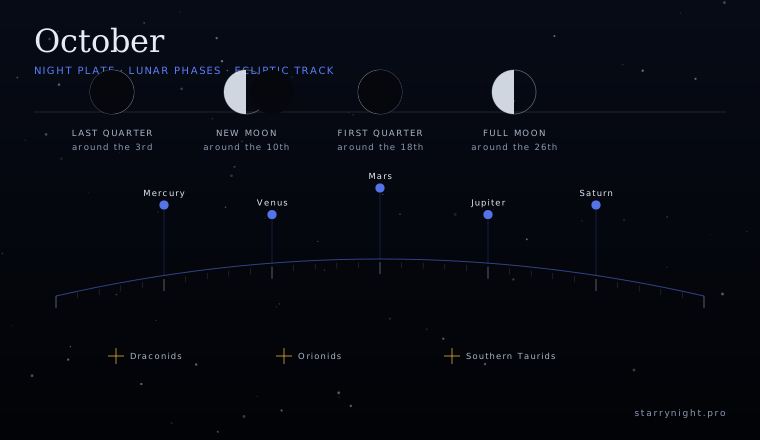
Mercury opens the month as a brief evening apparition, low in the west — catch it in the first week while twilight still has some colour in it, and expect a small, unsteady disk in any telescope. Venus leaves the evening sky around mid-October and reaches solar conjunction late in the month, so the run you have been following is ending; after that it is simply gone. Saturn is the easy one: well placed in the evening, past opposition, and visible for most of the night. A modest telescope at moderate power will show the rings and Titan without any fuss. Jupiter is the month's real project. Before dawn it is excellent — high and steady — and this is the right time to start a regular routine, watching the four Galilean moons change position from night to night in binoculars before pushing the magnification up. Mars is the difficult one: a brightening morning object that rises well before dawn, small enough that high power is genuinely worth trying.
Showers and dark windows
The Moon sets the schedule this month. New Moon falls around the 10th, so the best dark window lies either side of that date — and the Draconids arrive conveniently on the evening of 8–9 October, just before it. Their radiant sits in Draco, high in the north, so nothing has to rise before you can start: watch from dusk. Rates are usually under 10 per hour, though this shower is known for occasional storm levels, which is precisely why people bother with it. The Orionids peak on the night of 21–22 October at 15–20 per hour, radiant in Orion in the south-east, which pushes your session past midnight; the Moon near first quarter on the 18th sets in the small hours, so the second half of the night is the better half. The Full Moon of the 26th falls badly for the Orionids this year, and strongly reduced rates are expected. The Southern Taurids continue at about 5 per hour into November.
Planning your nights
Treat October as two campaigns. Evenings come first: Andromeda and Perseus are high in the east after 21:00 all month, so the first hour outside is productive long before the Moon becomes a problem. Field tip for week one: let your eyes adapt for a full twenty minutes, and use averted vision on whatever faintest target you attempt. Week two belongs to the Draconids on the evening of 8–9 October and to the New Moon around the 10th, the darkest nights you will get. Field tip: on a shower night you stand still for long stretches, so dress warmer than you think you need. The Orionids reward patience — the night of 21–22 October, after midnight, radiant in the south-east. Field tip: dew will fog your optics by 2 a.m.; a simple shield helps. Late in the month, set an alarm and go out before first light for Jupiter and Mars in the east.
Lunar phases
- Last quarter around the 3rd Dark evenings return after a bright start to the month.
- New Moon around the 10th The best dark window; the Orionids are building toward their peak.
- First quarter around the 18th Evening Moon; the Draconids peak a week earlier, so check the small hours.
- Full Moon around the 26th Unfavourable for the Orionid peak — expect strongly reduced rates this year.
Phase dates are approximate and quoted in UTC; confirm against a current almanac before you travel.
Planets this month
- Mercury A brief evening apparition early in the month, low in the west.
- Venus In solar conjunction late in the month; it disappears from the evening sky around mid-October.
- Mars A brightening morning object, rising well before dawn and now worth a look at high magnification.
- Jupiter Excellent in the pre-dawn sky, high and steady. This is the month to start a regular Jupiter observing routine.
- Saturn Still well placed in the evening, past opposition but visible for most of the night.
Meteor showers
-
Draconids
- Peak
- evening of 8–9 October
- Rate
- usually under 10 per hour; occasional storm levels
Unusual in peaking in the evening rather than after midnight. Radiant in Draco, high in the north.
-
Orionids
- Peak
- night of 21–22 October
- Rate
- 15–20 per hour
Debris from Halley's Comet, fast meteors with long trails. The nearly full Moon will wash out the fainter ones this year.
-
Southern Taurids
- Peak
- late October into November
- Rate
- 5 per hour
A long, broad peak with slow fireballs; overlaps with the Orionids.
Highlights
- The Double Cluster in Perseus is at its best — two dense clusters in one binocular field.
- M31 and M33 are both high; M33 is a genuine dark-sky test object.
- Jupiter dominates the pre-dawn sky, with all four Galilean moons visible in binoculars.
- The Pleiades return to the eastern evening sky, rising around 20:00 by month's end.
- The zodiacal light is often visible in the east before dawn from dark sites in autumn.
Night-by-night calendar
| Window | Event | Where to look |
|---|---|---|
| All month, evening | Andromeda and Perseus deep-sky fields | High in the east after 21:00 |
| 8–9 October, evening | Draconid meteor shower | Radiant in Draco, high in the north |
| Around the 10th | New Moon | Best dark window of the month |
| 21–22 October, after midnight | Orionid meteor shower | Radiant in Orion, south-east |
| Late October, pre-dawn | Jupiter and Mars | East, high before first light |
Field tips
Autumn is the best season for the Andromeda Galaxy in the northern hemisphere. Under a dark sky you can trace M31 out to nearly 3 degrees — three times the width of the full Moon. Follow the chain of stars from Mirach to find it, and use magnifications of 30x to 60x rather than high power; M31 is far too large to fit in a high-power field. For the Orionids, watch the sky the week either side of the peak instead of only on the peak night, since the Moon will interfere.
Note
StarryNight is an informational reference for amateur observers. Nothing here is professional astronomical, navigational or safety advice — always check a current almanac and your local weather before travelling to a dark site.
The same guide in the other language: 十月天象