Month 9 · sky guide
The sky in September
September is the pivot of the observing year. The summer Milky Way is still there in the west, the autumn galaxies are rising in the east, and Saturn is at its best.
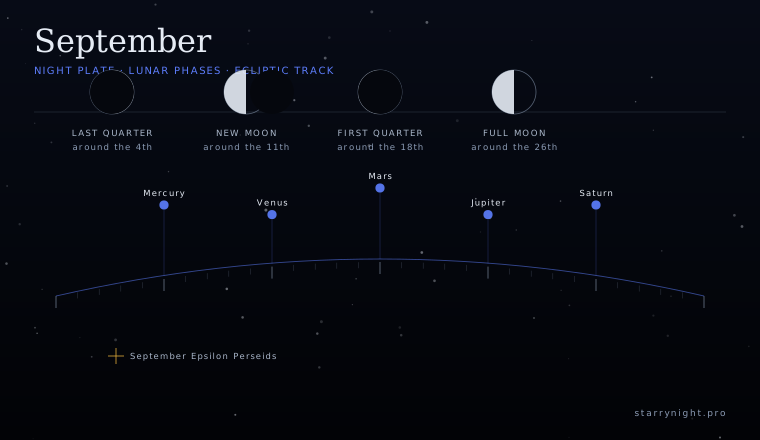
What the month looks like
At dusk the Summer Triangle is still prominent overhead, but by midnight it has moved west and the Great Square of Pegasus stands high in the east with Andromeda trailing from one corner. Saturn is at or near opposition, so it is up all night, at its brightest, and showing the rings near their maximum apparent width. The equinox falls around the 22nd, after which nights lengthen quickly. In the last hour before dawn, Orion and Sirius return to the south-east — the winter sky, arriving on schedule.
The month at a glance
The month's shape is set by a single bright event: Saturn reaches opposition, so it rises as the Sun sets and stays up until dawn. For a few weeks it is both the largest and the brightest it will be this year, and its rings — thin, but still wide enough to read at the eyepiece — are at their annual best. Meanwhile the sky is quietly turning over. By mid-evening the Great Square of Pegasus stands high in the east, and the two objects that hang off it — the Andromeda Galaxy and the Double Cluster in Perseus — are back in useful positions after their summer absence. On the 22nd the equinox arrives and night and day run nearly equal, which is a tidy way of marking the shift. The real signal, though, is before dawn: Orion climbs into the south-east, and with it the whole winter crew. The observing year is closing where it began.
Planets in detail
Mercury is the awkward one. A morning apparition is possible in the first half of the month, but it sits low in the east before dawn and needs a clear horizon and a patient eye; most observers will lose it to haze. Venus is easier to find but harder to study — low and brilliant in the evening twilight, setting soon after the Sun at northern latitudes, so catch it early and watch it through the worst of the murk. Mars is straightforward: a pre-dawn object brightening noticeably through the month. It is still small, and a telescope will not show much beyond a disc, but the colour is unmistakable. Jupiter is the planet for a small telescope — high before dawn, steady, and the Great Red Spot comes round on roughly alternate nights. Saturn, at opposition, is visible all night and is at its brightest and largest; even a modest instrument splits the rings from the globe.
Showers and dark windows
Two moon phases do most of the work here. Last quarter falls around the 4th, which leaves the pre-dawn hours dark — the window when Orion is climbing in the south-east. New Moon follows around the 11th, and that is the month's real gift: no moonlight at all, the best dark window of September. The September Epsilon Perseids peak around the 9th at under five meteors an hour, a modest shower by any standard, but the timing is lucky. It lands inside the dark run between last quarter and new Moon, so whatever it produces you will see against a genuinely black sky. The radiant sits in Perseus, which climbs through the night, so the hours after midnight give the better geometry. Bright nights return late in the month, with Full Moon around the 26th. A rate that low rewards patience over planning; a comfortable chair matters more than a wide field of view.
Planning your nights
Saturn is the anchor: at opposition it is up from dusk to dawn and sits near the meridian around midnight, so it never forces a schedule. Beyond that, the month divides by Moon. Week one, around the 4th, is pre-dawn territory — Orion rising in the south-east, Mars and Jupiter ahead of it, and no Moon to contend with. Tip: give your eyes twenty minutes before you judge the sky. Week two, around the 11th, is the galaxy window: Pegasus high, M31 and the Double Cluster both placed. Tip: low power and averted vision, because Andromeda only shows its full width when you look slightly away from it. Mid-month, by 22:00, the Great Square of Pegasus stands high in the east, and the equinox lands around the 22nd. The Moon then returns: first quarter on the 18th puts a fine terminator across the southern highlands. Tip: use high magnification on the terminator and on double stars, since the Moon spoils faint targets anyway. Full Moon on the 26th closes the month with bright nights.
Lunar phases
- Last quarter around the 4th A dark pre-dawn sky; good for Orion returning to the east.
- New Moon around the 11th The best dark window of the month.
- First quarter around the 18th Evening Moon with a good terminator across the southern highlands.
- Full Moon around the 26th Bright nights; a good window for double stars and bright clusters.
Phase dates are approximate and quoted in UTC; confirm against a current almanac before you travel.
Planets this month
- Mercury A morning apparition is possible in the first half of the month, low in the east before dawn.
- Venus Low and bright in the evening twilight; it sets soon after the Sun at northern latitudes.
- Mars A pre-dawn object, brightening noticeably. Still small, but the colour is unmistakable.
- Jupiter High in the pre-dawn sky and the best planet of the month for a telescope; the Great Red Spot is visible on roughly alternate nights.
- Saturn At or near opposition this month, which means it is at its brightest and largest, visible all night.
Meteor showers
-
September Epsilon Perseids
- Peak
- around 9 September
- Rate
- under 5 per hour
A minor shower with a short peak. Occasionally produces a brief outburst, so it is worth a glance if you are out anyway.
Highlights
- Saturn at opposition: the rings are at their best for the year, and the planet is visible from dusk to dawn.
- The Autumn Equinox falls around the 22nd, when night and day are nearly equal.
- The Great Square of Pegasus is high in the east by mid-evening, with Andromeda and M31 nearby.
- The Double Cluster in Perseus and the Andromeda Galaxy both return to good positions.
- Orion and the winter stars return to the pre-dawn sky, closing the observing year.
Night-by-night calendar
| Window | Event | Where to look |
|---|---|---|
| All month, all night | Saturn at opposition | In Aquarius/Capricornus region, near the meridian around midnight |
| Around the 11th | New Moon | Best window for the autumn galaxies |
| Mid-month, 22:00 | Great Square of Pegasus | High in the east |
| Around the 22nd | Autumn equinox | Night and day of nearly equal length |
| Late September, pre-dawn | Orion returns | South-east before first light |
Field tips
September is the month to start earlier. As the nights draw in, the most productive window moves from midnight to 21:00–01:00, which is far kinder to a working week. Saturn is worth real time this month: set up at 200x and wait for moments of steady air, then watch for the shadow of the rings on the planet's cloud tops and the dark Cassini Division. Sketch it once a week through the autumn and you will have a record of how the ring tilt changes.
Note
StarryNight is an informational reference for amateur observers. Nothing here is professional astronomical, navigational or safety advice — always check a current almanac and your local weather before travelling to a dark site.
The same guide in the other language: 九月天象