Zodiacal road · Sco
Scorpius, the Scorpion
Scorpius · Scorpii
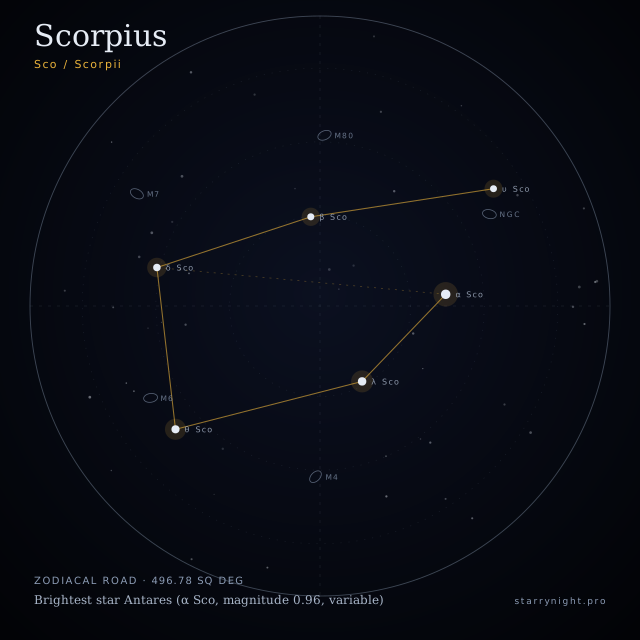
Scorpius is one of the very few constellations that actually looks like its name — a curved tail, a stinging hook, and a bright red heart at the top.
Physical profile
Scorpius covers 496.78 square degrees, just under 500; it is one of the 88 official constellations. That area is not empty sky: it wraps a curved, scorpion-shaped chain of stars from the head near Dschubba and Graffias to the tail anchored by Shaula and Lesath. Its brightest star, Antares, shines at magnitude 0.96 and is variable, so its exact brightness shifts slightly around that value. The spectral type M1.5Iab-Ib identifies a cool red supergiant, far larger and more luminous than the Sun; the M1.5 colour is visibly ruddy, and the Iab-Ib luminosity class places it among supergiants rather than ordinary giants. Latin gives the constellation name Scorpius; the genitive Scorpii is used in formal star names such as Alpha Scorpii, the Bayer designation of Antares. The same pattern applies to Shaula (Lambda Scorpii), Sargas (Theta Scorpii), Dschubba (Delta Scorpii), Graffias (Beta Scorpii), and Lesath (Upsilon Scorpii).
Star-hop to it
July evenings are the key. From roughly 25°S to 35°N, Scorpius is well placed, though northern observers see it low in the south while southern observers get it high overhead. Start from Ophiuchus, which borders Scorpius to the north: drop south from the Ophiuchus area toward the reddish star Antares, magnitude 0.96. Antares is the anchor. From there, trace the scorpion's body: Dschubba (mag 2.29) and Graffias (mag 2.62) mark the head, north and slightly west of Antares. Continue east and south to Sargas (mag 1.86), then to the tail stars Shaula (mag 1.62) and Lesath (mag 2.69), which form a close pair. If you are coming from Sagittarius, look west and slightly north; the tail of Scorpius points toward the Teapot region. From Libra, Scorpius lies to the east and south. Corona Australis, Ara, Norma, and Lupus lie farther south, so they are not useful northern anchors. In July, let Antares be your first target, then follow the curve.
Myth and culture
Scorpius is the scorpion of Greek myth, the creature sent to kill Orion. In one telling, Gaia sent it after Orion boasted he could slay every animal; in another, Artemis sent it. The two were placed on opposite sides of the sky, so Orion sets as Scorpius rises—a neat celestial revenge. As a zodiacal constellation, Scorpius lies on the Sun's apparent path, and the Sun passes through it in late November. Arabic star names preserve the scorpion's anatomy: Dschubba comes from jabhat al-'aqrab, the forehead; Shaula and Lesath relate to the raised tail or sting; Antares, though Greek for 'rival of Mars,' is also called Qalb al-'Aqrab, the scorpion's heart. In Chinese astronomy, Antares is Xinxiu Er, the second star of the Heart mansion, one of the 28 lunar mansions; the tail stars belong to Wei, the Tail mansion. Those names show the same shape read differently across cultures.
Deep-sky tour
Scorpius rewards a small telescope with two globulars and three open clusters. M4, at magnitude 5.9, sits close to Antares. Its light is spread out and grainy; a 150 mm scope can resolve stars across its face, but smaller apertures show only a soft glow. M80, magnitude 7.3, is smaller and denser, halfway between Antares and Graffias. At low power it looks like a fuzzy star; push magnification and aperture to pull out its tight core. The open clusters are easier. M6, the Butterfly Cluster, shines at magnitude 4.2, and is visible to the naked eye under dark skies; a low-power eyepiece shows its butterfly-like wings of stars. M7, the Ptolemy Cluster, is huge and brilliant at magnitude 3.3—the finest naked-eye cluster after the Pleiades—and may overflow a telescope field. NGC 6231, magnitude 2.6, is extremely rich but far south; it forms the core of the Scorpius OB1 association and is best from southern latitudes. In July, sweep the tail and the Antares region.
Catalogue data
| Latin name | Scorpius |
|---|---|
| IAU abbreviation | Sco |
| Genitive | Scorpii |
| Sky zone | Zodiacal road |
| Best from | Both hemispheres; best from 25°S–35°N |
| Best month | July |
| Area | 496.78 square degrees |
| Brightest star | Antares (α Sco, magnitude 0.96, variable) |
Story & naming
This is the scorpion that killed Orion. The two were placed on opposite sides of the sky so that the hunter sets as the scorpion rises, and they are never seen together. Antares means "rival of Mars", named for its deep reddish colour; the star is a red supergiant so large that if it replaced the Sun its surface would reach beyond the orbit of Mars.
How to find it
From mid-northern latitudes Scorpius crawls low along the southern horizon in July, and Antares is the reddish star at the top of the figure. From the southern hemisphere it stands overhead and the whole shape is obvious. Once you have Antares, follow the body down and to the east into the curved tail, ending at the close pair of Shaula and Lesath — the sting.
Main stars
| Star | Designation | Magnitude | Spectral type |
|---|---|---|---|
| Antares | α Sco | 0.96 | M1.5Iab-Ib |
| Shaula | λ Sco | 1.62 | B2IV |
| Sargas | θ Sco | 1.86 | F1II |
| Dschubba | δ Sco | 2.29 | B0.3IV |
| Graffias | β Sco | 2.62 | B1V + B2V |
| Lesath | υ Sco | 2.69 | B2IV |
Deep-sky objects
| Object | Type | Magnitude | Note |
|---|---|---|---|
| M4 | Globular cluster | 5.9 | Loose and grainy; a 150 mm scope resolves stars across its face. |
| M6 Butterfly Cluster | Open cluster | 4.2 | Bright and shaped like a butterfly; visible to the naked eye. |
| M7 Ptolemy Cluster | Open cluster | 3.3 | Huge and brilliant — the finest naked-eye cluster after the Pleiades. |
| M80 | Globular cluster | 7.3 | Small and dense, halfway between Antares and Graffias. |
| NGC 6231 | Open cluster | 2.6 | Extremely rich but far south; the core of the Scorpius OB1 association. |
Observing notes
Antares has a greenish companion 2.5 arcseconds away that needs steady air and about 150x — one of the classic colour-contrast doubles. M4 and M80 flank Antares within a few degrees and make a good comparison: M4 is loose and easily resolved, M80 is compact and stubborn. The tail region holds M6 and M7, both naked-eye clusters that are magnificent in binoculars; M7 alone spans more than a degree and a half.
Bordering constellations
- Libra
- Ophiuchus
- Sagittarius
- Corona Australis
- Ara
- Norma
- Lupus
Note
StarryNight is an informational reference for amateur observers. Nothing here is professional astronomical, navigational or safety advice — always check a current almanac and your local weather before travelling to a dark site.
The same sheet in the other language: 天蝎座 Scorpius