Southern sky · CMa
Canis Major, the Greater Dog
Canis Major · Canis Majoris
Canis Major holds Sirius, the brightest star in the night sky, and a supporting cast of four more stars brighter than third magnitude — an unusually bright constellation.
Physical profile
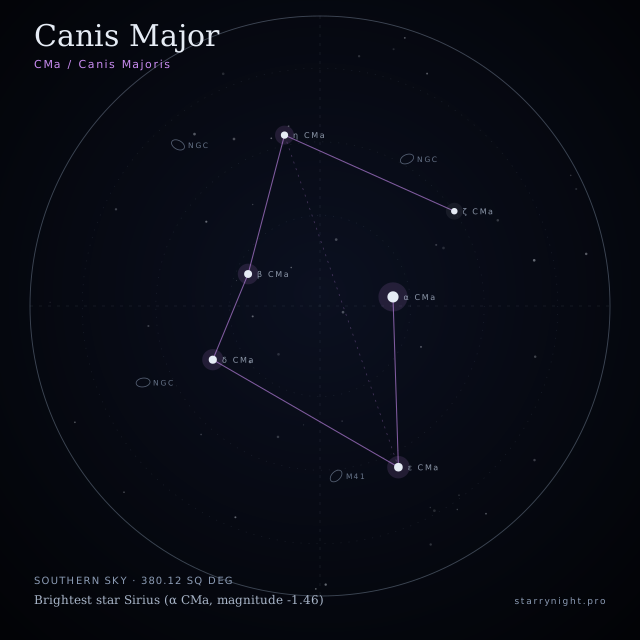
Canis Major occupies 380.12 square degrees, a middling patch of the 88 official constellations. It is not one of the sprawling northern giants, but it is large enough to hold a recognizable dog shape. The catalogue places it in both hemispheres, though observers need to be south of 30°N to see the whole figure; February is its best month. Its brightest star, Sirius, has magnitude -1.46, making it the night sky's most brilliant star. The spectral type A1V + DA2 tells a binary story: a white main-sequence primary paired with a white dwarf companion. That combination is unusual among naked-eye stars, and it makes Sirius a binary system rather than a single point of light. The other main stars span a wider range: Adhara is B2II, Wezen F8Ia, Mirzam B1II-III, Aludra B5Ia, Furud B2.5V. The Latin name Canis Major means Greater Dog; the genitive Canis Majoris appears in designations such as α Canis Majoris, not α Canis Major.
Star-hop to it
February evenings give the best view. From any site south of 30°N, the whole constellation is above the horizon; northern observers farther north lose part of the dog's hindquarters, while southern-hemisphere viewers see Canis Major high in the north. Sirius is the anchor. It blazes below Orion's Belt, but you can also arrive from the listed neighbours. From Lepus, the Hare, which lies north-west, drop east-south-east from Arneb toward Sirius. From Monoceros, the faint unicorn to the east, look south-west for the same brilliant star. From Puppis, east-south-east, face west; from Columba, south-west, look north-east. Once at Sirius, Mirzam is west, Adhara south, Wezen east-south-east, Aludra farther east, and Furud south-west. The bright triangle of Sirius, Mirzam and Wezen frames the dog's head and shoulders; Adhara and Wezen mark the hind legs. M41 hangs directly below Sirius, a naked-eye smudge from a dark site.
Myth and culture
Canis Major is Orion's hunting dog. In Greek sky lore, the giant hunter Orion is never far from his hound, and Sirius—whose name comes from a Greek word for scorching or sparkling—was watched for its heliacal rising, the dawn appearance that announced the summer heat and the 'dog days.' That single star carried more seasonal weight than the rest of the constellation combined. Other cultures read the same pattern differently. Arabic star names survive across the dog: Mirzam is 'the herald,' because it rises before Sirius; Adhara comes from al-‘Adhārā, 'the virgins'; Wezen from al-Wazn, 'the weight.' In Chinese astronomy, Sirius is 天狼, the Celestial Wolf, and the nearby bow-and-arrow asterism 弧矢 is aimed toward it—an image of watchfulness rather than companionship. The Greek dog and the Chinese wolf share a star, but they carry opposite moods: one loyal, one dangerous, both unforgettable.
Deep-sky tour
The deep-sky list is short but well matched to small telescopes. M41—also NGC 2287—is an open cluster of magnitude 4.5, sitting right below Sirius. Under dark skies it is a naked-eye smudge, but binoculars or a low-power eyepiece turn it into a loose spray of stars. Because M41 and NGC 2287 are the same object, there is no second target to hunt. NGC 2362, the Tau Cluster, is an open cluster of magnitude 4.1, compact around Tau Canis Majoris. Its age of 5 million years means it is young, so expect hot blue stars packed into a small area; medium power splits the knot around Tau. NGC 2359, Thor's Helmet, is an emission nebula of magnitude 11.5, a spectacular bubble blown by a Wolf-Rayet star. This is the difficult one. An OIII filter is needed to raise contrast, and even then a dark site and moderate aperture help; without the filter the nebula may disappear. The contrast between the 4th-magnitude clusters and the 11.5-magnitude nebula is the real story here.
Catalogue data
| Latin name | Canis Major |
|---|---|
| IAU abbreviation | CMa |
| Genitive | Canis Majoris |
| Sky zone | Southern sky |
| Best from | Both hemispheres; fully visible south of 30°N |
| Best month | February |
| Area | 380.12 square degrees |
| Brightest star | Sirius (α CMa, magnitude -1.46) |
Story & naming
The greater dog is one of Orion's two hunting hounds, following at his heel with Canis Minor. Some Greek sources instead call it the dog of Icarius, who was killed by shepherds after they drank the wine he gave them, and whose dog Maera guided searchers to the body. Sirius itself was watched carefully across the ancient world: its dawn rising marked the Nile flood in Egypt and the "dog days" of late summer in Rome.
How to find it
Find Orion's belt, then follow the line of the three stars down and to the left for about 25 degrees. Sirius is dramatically brighter than anything else in the sky — there is no ambiguity once it is up. Mirzam rises slightly before it and is sometimes called the Announcer. The rest of the dog extends south-east of Sirius, ending at Wezen and Adhara.
Main stars
| Star | Designation | Magnitude | Spectral type |
|---|---|---|---|
| Sirius | α CMa | -1.46 | A1V + DA2 |
| Adhara | ε CMa | 1.5 | B2II |
| Wezen | δ CMa | 1.83 | F8Ia |
| Mirzam | β CMa | 1.98 | B1II-III |
| Aludra | η CMa | 2.45 | B5Ia |
| Furud | ζ CMa | 3.02 | B2.5V |
Deep-sky objects
| Object | Type | Magnitude | Note |
|---|---|---|---|
| M41 | Open cluster | 4.5 | Right below Sirius and naked-eye from a dark site; a fine low-power target. |
| NGC 2359 Thor's Helmet | Emission nebula | 11.5 | A spectacular bubble blown by a Wolf-Rayet star; needs an OIII filter. |
| NGC 2362 Tau Cluster | Open cluster | 4.1 | Compact cluster around the star Tau Canis Majoris — 5 million years old. |
| NGC 2287 is M41 | Open cluster | 4.5 | Also catalogued as NGC 2287 — the same object under two numbers. |
Observing notes
Sirius is famous for twinkling violently when low, flashing red, white and blue; the effect fades as it climbs. It also has a white-dwarf companion, Sirius B, only about 11 arcseconds away and hidden in the glare — a classic test of both optics and seeing, needing 200 mm and steady air. M41 sits just 4 degrees south of Sirius and is a fine sight in binoculars, with a bright orange star near its centre.
Bordering constellations
- Monoceros
- Lepus
- Columba
- Puppis
Note
StarryNight is an informational reference for amateur observers. Nothing here is professional astronomical, navigational or safety advice — always check a current almanac and your local weather before travelling to a dark site.
The same sheet in the other language: 大犬座 Canis Major