Northern sky · Cas
Cassiopeia, the Seated Queen
Cassiopeia · Cassiopeiae
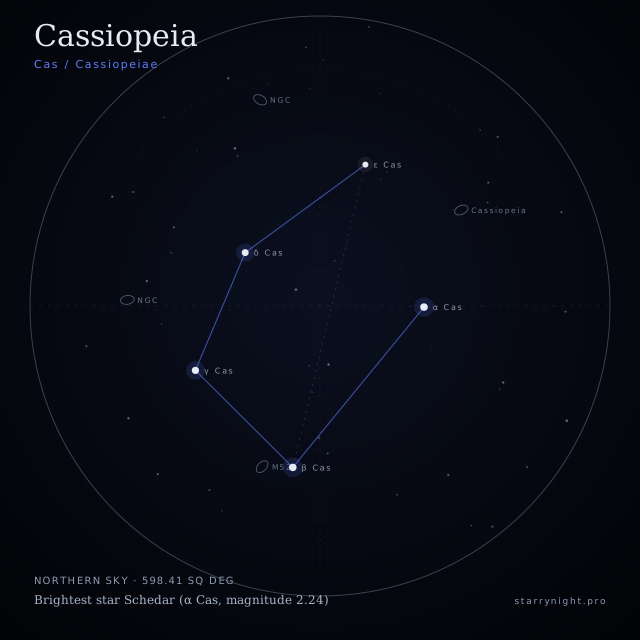
Cassiopeia is the W-shaped constellation opposite the Big Dipper across the pole. In autumn it stands high overhead; in spring it hangs low and inverted, which is why beginners often fail to recognise it.
Physical profile
Cassiopeia covers 598.41 square degrees, a generous patch of the northern sky but only one entry among the 88 constellations. That area is about 1.5 percent of the celestial sphere, enough to hold a five-star W but not enough to make it a giant like Hydra. Its brightest star, Schedar, glows at magnitude 2.24. That is bright enough for easy naked-eye sightings from suburban skies, yet it stops short of the first-magnitude elite; Caph at 2.28 sits almost on its heels. Schedar's K0IIIa spectral type marks it as an orange giant, a star that has left the main sequence and swollen cool and luminous. The rest of the main pattern is a mix: Gamma Cassiopeiae is B0.5IVpe, a hot blue subgiant with emission lines, while Ruchbah is A5III-IV and Segin B3III. The Latin name Cassiopeia becomes Cassiopeiae in the genitive, so Bayer designations read Alpha Cassiopeiae, Beta Cassiopeiae, and so on.
Star-hop to it
Above 45°N Cassiopeia never sets; from 35°N it is well placed in November, the month when its W stands nearly overhead around local midnight. The easiest route is from Polaris. Find the Big Dipper, follow the two Pointer stars to Polaris, then look opposite the Dipper: Cassiopeia's five bright stars make a flattened W or M, roughly the same distance from Polaris as the Dipper. Cepheus lies immediately beyond the W's open side, toward Polaris; Camelopardalis, a dim giraffe, occupies the space between Cassiopeia and the Dipper. From Andromeda, start at Alpheratz and sweep through Mirach and Almach; continue northwest and the W appears. Perseus is next door to the southeast: locate Mirfak and Algol, then look north-northwest for Caph and Schedar. Lacerta, a faint lizard, fills the gap between Cassiopeia and Cygnus. In November, let Schedar and Caph point you: they form the right-hand end of the W as it faces north.
Myth and culture
Cassiopeia is the boastful queen of Greek myth: wife of Cepheus, mother of Andromeda, she claimed beauty greater than the Nereids. Poseidon answered with a sea monster, and only Perseus's rescue of Andromeda ended the crisis. The gods set her in the sky on a throne, sometimes described as hanging upside down for half the night—a punishment for vanity. Arabic astronomers gave the constellation's stars names that survive: Schedar from şadr, 'breast' or 'chest'; Caph from kaf, 'palm'; Ruchbah from rukbah, 'knee.' In Chinese astronomy the same W was not a queen but Wang Liang, a legendary charioteer, with Caph and Schedar among the stars of his asterism. That overlap shows how one bright pattern can carry unrelated stories. The queen's name remains attached to the whole figure, while individual stars carry Arabic labels. The sky keeps multiple readings: a punished queen for Greek myth, a charioteer for Chinese star lore, and Arabic body-part labels for individual stars.
Deep-sky tour
Cassiopeia's deep-sky list rewards small telescopes. M52, an open cluster at magnitude 6.9, appears as a rich, compressed knot of faint stars; at low power it resembles a granular puff, and higher magnification splits it into dozens of members. The Bubble Nebula lies only 35 arcminutes away, close enough to share a low-power field, though the bubble itself is faint and needs dark skies. NGC 457, the Owl Cluster, shines at magnitude 6.4 and is the easiest of the group: two bright stars form the eyes, while a chain of fainter stars traces the body, giving an unmistakable owl or stick figure. NGC 281, the Pacman Nebula, is an emission nebula at magnitude 7.4; its dark notch creates the bite-shaped silhouette, but an OIII or UHC filter is essential to make the nebulosity stand out from the rich Milky Way background. Cassiopeia A is different: a supernova remnant listed at magnitude 12.0 in radio, it is the brightest radio source beyond the solar system, yet it is invisible visually. Small telescopes show none of it; radio dishes see the rest.
Catalogue data
| Latin name | Cassiopeia |
|---|---|
| IAU abbreviation | Cas |
| Genitive | Cassiopeiae |
| Sky zone | Northern sky |
| Best from | 35°N and northward (circumpolar above 45°N) |
| Best month | November |
| Area | 598.41 square degrees |
| Brightest star | Schedar (α Cas, magnitude 2.24) |
Story & naming
Cassiopeia was the boastful queen of Aethiopia who claimed she was more beautiful than the Nereids. The sea gods sent a monster, her daughter Andromeda was chained to a rock, and Perseus eventually rescued her. As punishment the queen was bound to a throne in the sky, condemned to circle the pole upside down for half of every night. The five bright stars trace that chair — a genuine W from autumn through winter, and an M in spring.
How to find it
Draw a line from the Big Dipper's pointer stars through Polaris and keep going the same distance on the other side: you arrive at the middle of the W. Alternatively, from Andromeda follow the two fainter stars that continue past Almach. In November the W stands almost upright on its end in the north-east after dark.
Main stars
| Star | Designation | Magnitude | Spectral type |
|---|---|---|---|
| Schedar | α Cas | 2.24 | K0IIIa |
| Caph | β Cas | 2.28 | F2III-IV |
| Gamma Cassiopeiae | γ Cas | 2.47 | B0.5IVpe |
| Ruchbah | δ Cas | 2.68 | A5III-IV |
| Segin | ε Cas | 3.35 | B3III |
Deep-sky objects
| Object | Type | Magnitude | Note |
|---|---|---|---|
| M52 | Open cluster | 6.9 | Rich compressed cluster; the Bubble Nebula sits 35 arcminutes away. |
| NGC 457 Owl Cluster | Open cluster | 6.4 | Two bright stars make eyes, a chain of faint ones makes the body. |
| NGC 281 Pacman Nebula | Emission nebula | 7.4 | Needs an OIII or UHC filter; the dark notch gives it the name. |
| Cassiopeia A | Supernova remnant | 12.0 (radio) | The brightest radio source beyond the solar system; invisible visually. |
Observing notes
Caph and Schedar make a good first binocular field: NGC 457 sits just off Ruchbah and looks like a stick figure with two bright eyes, which is where its Owl Cluster nickname comes from. Gamma Cassiopeiae is an eruptive variable that has dropped from magnitude 1.6 to 3.0 in recorded history — worth a naked-eye comparison against Schedar each season.
Bordering constellations
Note
StarryNight is an informational reference for amateur observers. Nothing here is professional astronomical, navigational or safety advice — always check a current almanac and your local weather before travelling to a dark site.
The same sheet in the other language: 仙后座 Cassiopeia