Northern sky · Cep
Cepheus, the King
Cepheus · Cephei
Cepheus is a dim house-shaped outline wedged between Cassiopeia and the pole. It matters far out of proportion to its brightness: this patch of sky gave astronomers both the Cepheid yardstick and a black hole.
Physical profile
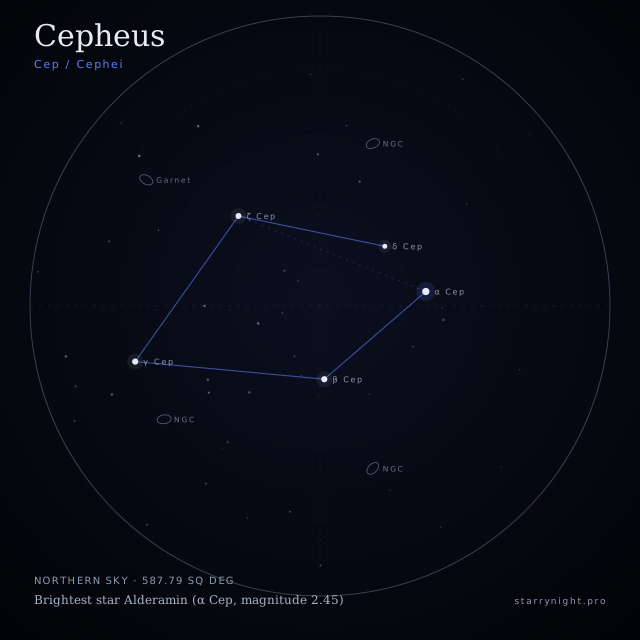
Cepheus occupies 587.79 square degrees of sky, a middling-to-large figure among the 88 constellations — big enough to hold several distinct star patterns, compact enough that its house-shaped outline survives inside a single binocular field. Its brightest star, Alderamin, glows at magnitude 2.45. That is respectable but not spectacular: it lies well below Sirius at -1.46, so Cepheus never blazes the way Orion does. Alderamin's A7IV-V type describes a white star poised between the subgiant and main-sequence stages, hotter and whiter than the Sun. The other listed types reward a second look. Alfirk's B2IIIv and Delta Cephei's double entry, F5Ib–G1Ib, both flag variable stars — and each is the prototype of its own class. Naming runs through the genitive: 'Cepheus' is the Latin nominative, 'Cephei' the possessive, so α Cephei means 'the alpha of Cepheus,' the same construction behind Alpha Centauri and Beta Cygni.
Star-hop to it
Cepheus never sets for observers above 45°N and stays up all night from 35°N northward; October, when it rides highest in the evening sky, is the easiest month to trace it. Begin at Polaris. North of the pole star sits the house-shaped asterism, a squat pentagon whose northern corner, Errai (γ Cep), aims back toward Polaris, and whose southern edge, marked by Alderamin, runs along the Lacerta and Cygnus borders. Cassiopeia's W is the other signpost. Take its two western stars, Schedar and Caph, and extend the line through them by three or four times their separation; you land on Alderamin, at 2.45 the brightest thing in that patch. From Cygnus, look north from first-magnitude Deneb — Alderamin lies a couple of fist-widths almost due north. With Alderamin fixed, Alfirk and Errai at 3.23 and 3.21 close the sides of the house, while Zeta and Delta Cephei at 3.35 and 4.07 sit inside it.
Myth and culture
Cepheus is a king, and a passive one. In Greek myth he ruled Aethiopia, married the boastful Cassiopeia, and fathered Andromeda. When Cassiopeia claimed her beauty outshone the Nereids, Poseidon flooded the land and sent the sea monster Cetus; an oracle demanded Andromeda as a sacrifice, and Cepheus chained her to a rock — some tellings have him weeping, others simply complying. Perseus arrived, killed Cetus, and married her. Cepheus's part is to stand by, and the sky reflects it: he keeps company with his wife, his daughter and the monster, but the story belongs to them. Arabic star names tell a separate tale. Alfirk (β) derives from al-firq, 'the flock'; Errai (γ) from al-rāʿī, 'the shepherd'; Alderamin (α) from al-dhirāʿ al-yamīn, 'the right arm.' Chinese astronomers drew different lines: Delta and Epsilon Cephei marked Zaofu, named for a legendary charioteer, while Alderamin was Tiāngōu wǔ, fifth star of the Celestial Hook, both within the Purple Forbidden Enclosure.
Deep-sky tour
Cepheus rewards sweeping because its southern half lies along the Milky Way. Begin with NGC 7023, the Iris Nebula: a reflection nebula and cluster at magnitude 6.8, wrapped around a seventh-magnitude star. A small telescope shows the star and a soft blue glow — starlight bounced off dust rather than gas, the same scattering that makes the daytime sky blue. A dark lane rims the glow, and that frame earned the object its name. NGC 7380, the Wizard, is an emission nebula plus open cluster at magnitude 7.2; its stars resolve fairly easily, but the wizard-shaped shock front demands long exposures or a nebula filter. The Garnet Star, Mu Cephei, is the outlier: a variable red supergiant at magnitude 4.08 and one of the largest stars known, plainly orange-red in binoculars, its hue betraying a cool surface. Finally NGC 188: magnitude 8.1, about 6 billion years old, one of the oldest open clusters known — a dim, yellow-tinged swarm lacking the hot blue stars young clusters flaunt.
Catalogue data
| Latin name | Cepheus |
|---|---|
| IAU abbreviation | Cep |
| Genitive | Cephei |
| Sky zone | Northern sky |
| Best from | 35°N and northward (circumpolar above 45°N) |
| Best month | October |
| Area | 587.79 square degrees |
| Brightest star | Alderamin (α Cep, magnitude 2.45) |
Story & naming
Cepheus was king of Aethiopia, husband of the boastful Cassiopeia and father of Andromeda. He appears in the sky as a simple gabled square, dimmer than his wife and daughter, which poets liked to read as a comment on his role in the family disaster. The name of its brightest star, Alderamin, comes from the Arabic for "the right arm" — the king's outstretched limb.
How to find it
Locate the W of Cassiopeia, then look for the faint square of stars just inward toward Polaris. Alderamin is the corner nearest Cassiopeia. The house shape is roughly 10 degrees across, so a binocular field catches only a corner at a time. From Alderamin, Errai and Alfirk run up the eastern wall.
Main stars
| Star | Designation | Magnitude | Spectral type |
|---|---|---|---|
| Alderamin | α Cep | 2.45 | A7IV-V |
| Alfirk | β Cep | 3.23 | B2IIIv |
| Errai | γ Cep | 3.21 | K1III-IV |
| Zeta Cephei | ζ Cep | 3.35 | K1.5Ib |
| Delta Cephei | δ Cep | 4.07 | F5Ib-G1Ib |
Deep-sky objects
| Object | Type | Magnitude | Note |
|---|---|---|---|
| NGC 7023 Iris Nebula | Reflection nebula + cluster | 6.8 | Blue reflection glow around a 7th-magnitude star; a dark halo frames it. |
| NGC 7380 Wizard Nebula | Open cluster + emission | 7.2 | Long exposures show a wizard-shaped shock front. |
| Garnet Star (μ Cep) | Red supergiant | 4.08 (var) | One of the largest known stars, unmistakably orange-red in binoculars. |
| NGC 188 | Open cluster | 8.1 | One of the oldest open clusters known, about 6 billion years old. |
Observing notes
Delta Cephei is the prototype of the Cepheid variables and the reason we can measure the distance to other galaxies: it swings between magnitude 3.5 and 4.4 in 5.37 days, an easy naked-eye estimate against nearby comparison stars. Mu Cephei, the Garnet Star, is a red supergiant so colour-saturated that it looks ruby against the white field. NGC 7023 rewards a dark sky far more than aperture.
Bordering constellations
- Ursa Minor
- Camelopardalis
- Cassiopeia
- Andromeda
- Lacerta
- Cygnus
- Draco
Note
StarryNight is an informational reference for amateur observers. Nothing here is professional astronomical, navigational or safety advice — always check a current almanac and your local weather before travelling to a dark site.
The same sheet in the other language: 仙王座 Cepheus