Northern sky · Boo
Boötes, the Herdsman
Bootes · Bootis
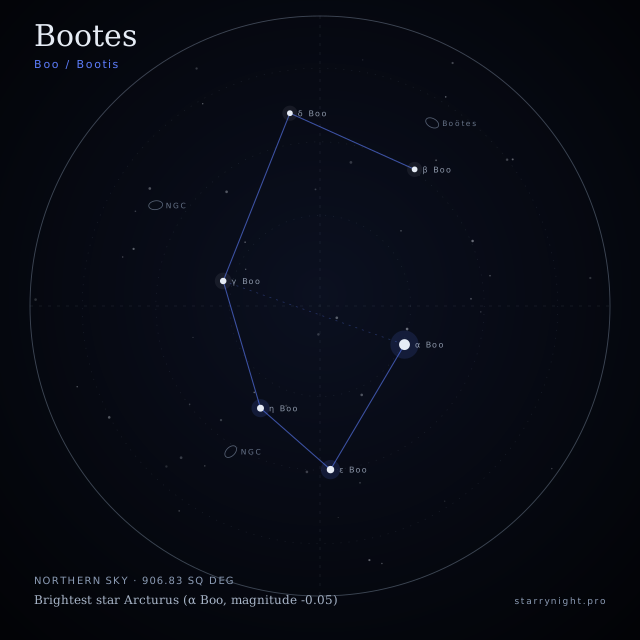
Boötes is a kite-shaped constellation anchored by Arcturus, the brightest star in the northern celestial hemisphere and the first one ever seen to move across the sky.
Physical profile
Boötes occupies 906.83 square degrees, which sounds generous until you spread it against the 88 figures that tile the whole sky: it sits in the large middle tier, bigger than Corona Borealis next door but far short of sprawling Hydra. Its prize is Arcturus, α Boötis, at magnitude −0.05 — a negative number that means it outshines almost everything overhead and, from mid-northern latitudes, is the brightest star in the northern celestial hemisphere. The spectral type K1.5III tells the story of why: the K says orange, the 1.5 is a fine subdivision within that class, and the Roman III marks a giant, a star that has swollen and cooled after exhausting the hydrogen in its core. Naming works off the Latin. Boötes is the nominative form, the name you say aloud; Boötis is the genitive, the form that carries possession, so Bayer's Greek letters attach to it — α Boötis, ε Boötis, β Boötis — never to the nominative.
Star-hop to it
Boötes rewards the simplest star-hop in the sky. Find the Big Dipper — Ursa Major, one of Boötes's eight neighbours — and follow the curve of its handle away from the bowl. That arc, extended roughly one handle-length, lands on Arcturus, the constellation's great orange lantern. From there the body of Boötes fans northward: a kite, or a cone, of stars with Arcturus at the pointed southern tip. Because the whole figure lies at 35°N and northward, it is a fixture of spring and early summer evenings, culminating in June. The rest is easy once Arcturus is anchored. Izar, ε Boötis at magnitude 2.35, holds the kite's western edge, northwest of Arcturus; Muphrid, η Boötis at 2.68, hovers just above Arcturus itself, the closest of the named stars to the anchor. Seginus, γ Boötis at 3.03, marks the northern shoulder. Corona Borealis and Hercules close off the eastern side, while Draco, Canes Venatici and Coma Berenices crowd the west.
Myth and culture
The Greek name is a job description: Boötes, from βοώτης, 'ox-driver,' a ploughman or herdsman, and the figure is usually cast as the Bear Watcher, driving the two bears — Ursa Major and Ursa Minor — around the pole. Myth-makers also tied him to Arcas, son of Callisto, whose own story ends with both mother and son set in the stars. Arabic astronomers left a deeper mark on the individual stars than the Greek farmer did on the outline. Arcturus itself is Greek for 'guardian of the bear,' but Izar, ε Boötis, comes from ʾizār, 'the veil' or loincloth; Muphrid, η Boötis, from mufrid al-rāmih, 'the solitary one of the lancer'; and Nekkar, β Boötis, from al-baqqār, 'the ox-herder' — the same trade the Greeks imagined, named again in another language. In the Chinese sky the picture dissolved entirely. Its brightest star became Dàjiǎo, the Great Horn, a key marker of the Azure Dragon of the East.
Deep-sky tour
Boötes is not a deep-sky showpiece, but it holds three objects worth the trip. NGC 5466 is a globular cluster at magnitude 9, and its catalogued oddity is real at the eyepiece: most globulars are dense, blazing cores, while this one is conspicuously loose, its stars thinly spread and hard to separate from the field. Those are the faintest stars you are resolving; through a 200 mm scope the outer edges break into granular points, and a dark, transparent night helps more than aperture does. NGC 5248 is a barred spiral, SBbc, at magnitude 10.2. It is small and near face-on, which is exactly why the two bright arms stand out against a soft disc — a challenge object for a small telescope under rural skies, revealed by averted vision rather than direct staring. The third target needs no telescope at all. The Boötes Void, 250 million light-years across, is a bubble of near-nothing centred near Nekkar; its emptiness is the point, and only the largest surveys map its edges.
Catalogue data
| Latin name | Bootes |
|---|---|
| IAU abbreviation | Boo |
| Genitive | Bootis |
| Sky zone | Northern sky |
| Best from | 35°N and northward |
| Best month | June |
| Area | 906.83 square degrees |
| Brightest star | Arcturus (α Boo, magnitude -0.05) |
Story & naming
The herdsman is usually Arcas, son of Callisto, set beside his mother in the sky. Some versions make him the inventor of the plough, rewarded with a place in the heavens. Arcturus means "guardian of the bear" in Greek — it sits just behind the Great Bear's tail, as if driving it around the pole. Edmond Halley compared the star's position in 1718 with ancient Greek records and found it had shifted, the discovery that revealed proper motion.
How to find it
Follow the arc of the Big Dipper's handle away from the bowl — "arc to Arcturus". The star is a warm orange point that stands alone; nothing nearby rivals it. From Arcturus, continue the same curve downward to Spica in Virgo. The rest of Boötes extends upward toward Corona Borealis in a narrow kite of second- and third-magnitude stars.
Main stars
| Star | Designation | Magnitude | Spectral type |
|---|---|---|---|
| Arcturus | α Boo | -0.05 | K1.5III |
| Izar | ε Boo | 2.35 | K0II-III + A2V |
| Muphrid | η Boo | 2.68 | G0IV |
| Seginus | γ Boo | 3.03 | A7III |
| Delta Bootis | δ Boo | 3.47 | G8III |
| Nekkar | β Boo | 3.49 | G8IIIa |
Deep-sky objects
| Object | Type | Magnitude | Note |
|---|---|---|---|
| NGC 5466 | Globular cluster | 9 | Very loose for a globular; a 200 mm scope resolves the edges. |
| NGC 5248 | Barred spiral (SBbc) | 10.2 | Small face-on spiral with two bright arms. |
| Boötes Void | Cosmic void | — | A 250-million-light-year bubble almost empty of galaxies, centred near Nekkar. |
Observing notes
Arcturus has a distinctly yellow-orange tint that is obvious to the naked eye next to Spica's blue-white. Izar is one of the best spring doubles: a gold primary paired with a blue-green companion that needs about 150x to split cleanly. The Boötes Void is invisible, but knowing you are looking into a region almost devoid of galaxies adds a strange feeling under a dark sky.
Bordering constellations
- Draco
- Ursa Major
- Canes Venatici
- Coma Berenices
- Virgo
- Serpens Caput
- Corona Borealis
- Hercules
Note
StarryNight is an informational reference for amateur observers. Nothing here is professional astronomical, navigational or safety advice — always check a current almanac and your local weather before travelling to a dark site.
The same sheet in the other language: 牧夫座 Boötes