Northern sky · CrB
Corona Borealis, the Northern Crown
Corona Borealis · Coronae Borealis
A small, tidy semicircle of stars between Boötes and Hercules — the only crown in the sky that genuinely looks like a crown.
Physical profile
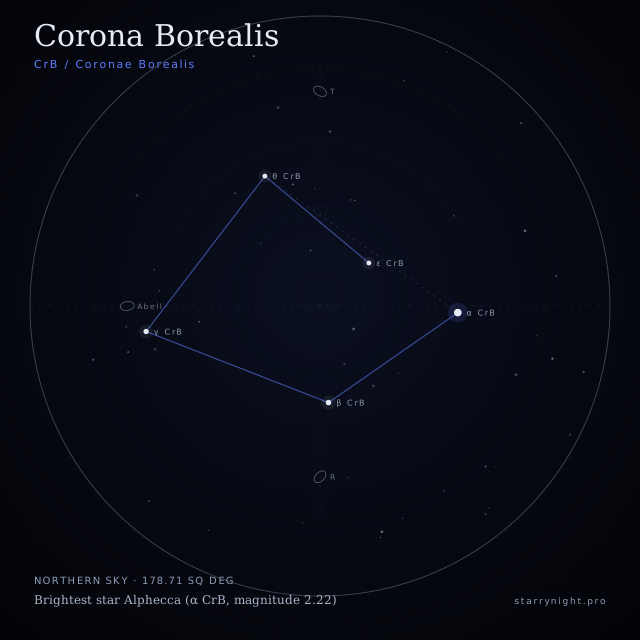
Corona Borealis occupies 178.71 square degrees, a modest patch among the 88 constellations — roughly four-tenths of one percent of the 41,253 square degrees in the whole sky. Its brightest star, Alphecca, shines at magnitude 2.22, so it is comfortably naked-eye but not first-magnitude; no star in the constellation breaks that brighter barrier. Alphecca's spectral type is A0V + G5V, which means a hot white main-sequence primary paired with a cooler, Sun-like companion. That combination explains why the star looks white with a hint of blue rather than solar yellow. The Latin name Corona Borealis translates as 'Northern Crown,' and its genitive form, Coronae Borealis, is the one used in catalogue designations: Alpha Coronae Borealis, Beta Coronae Borealis, and so on. The remaining main stars range from Nusakan at magnitude 3.66 through Gamma at 3.84, Theta and Epsilon both at 4.14, spanning F, B, and K spectral classes. The constellation is therefore a small, second-magnitude-tier figure with a single standout star and a mixed population of hotter and cooler suns.
Star-hop to it
Start with Bootes. Its brilliant orange star Arcturus is one of the easiest anchors in the northern sky, and Corona Borealis lies about 20 degrees east-northeast of it — roughly two fist-widths at arm's length. From Arcturus, sweep toward the Keystone of Hercules, the four-star trapezoid marking the hero's torso. Corona Borealis sits between them, closer to Hercules than to Arcturus, appearing as a shallow semicircle of stars about 10 degrees across. Alphecca, the brightest jewel, marks one end of the arc; Nusakan lies on the opposite side. If you have found the Keystone, look west-northwest to locate the crown. Serpens Caput lies farther south, useful mainly as a reminder that you are in the right general region. At 40°N and northward, July evenings bring the constellation highest, near the meridian and sometimes close to overhead. Farther north it rides higher still, staying a spring-through-autumn evening target rather than a permanent one. A dark sky helps, but Alphecca at magnitude 2.22 is easy even from suburbia.
Myth and culture
Greek myth identifies Corona Borealis as the crown of Ariadne. After Theseus abandoned her on Naxos, Dionysus found her, married her, and set her wedding crown in the sky; some versions say the crown was made by Hephaestus and studded with gems. The constellation's semicircular arc fits the diadem neatly. The Arabic tradition gave the figure a different reading: al-Fakkah, 'the broken ring,' a shape that matches the visible stars even better than a crown. From that phrase come the name Alphecca, from al-Na'ir al-Fakkah, 'the bright one of the broken ring,' and Nusakan, from al-Nasaqān, 'the two lines.' In Chinese astronomy the same arc belonged to Guan Suo, the Coiled Thong, a chain of stars associated with a prison or cord. That reading turns the graceful crown into a legal or punitive symbol, a reminder that asterisms are cultural inventions, not permanent pictures. Polynesian and other traditions have their own crown or circle stories, but the Greek and Arabic layers are the ones that survive in modern star names.
Deep-sky tour
R Coronae Borealis is the constellation's strangest star. For years it sits near magnitude 6, just at the naked-eye threshold, then suddenly fades by four magnitudes in a matter of weeks, dropping to 14.8. That plunge happens because the star puffs out carbon dust that blocks its light; small telescopes lose it completely during an episode, while a 6- to 8-inch scope can follow it only before or after the fade. Abell 2065 is a dense galaxy cluster at magnitude 13.8, packed with several hundred galaxies, but only the brightest few are within reach of amateur instruments. Even a large Dobsonian under dark skies shows them as faint, small smudges, not the rich cluster photographs suggest. T Coronae Borealis is a recurrent nova that normally hovers near magnitude 10.8, visible in a small telescope, and erupts roughly every 80 years. Its last outburst was in 1946. At maximum it reaches magnitude 2.0, briefly outshining Alphecca and adding a temporary jewel to the crown. The next eruption is due around the 2020s, though the timing is never exact.
Catalogue data
| Latin name | Corona Borealis |
|---|---|
| IAU abbreviation | CrB |
| Genitive | Coronae Borealis |
| Sky zone | Northern sky |
| Best from | 40°N and northward |
| Best month | July |
| Area | 178.71 square degrees |
| Brightest star | Alphecca (α CrB, magnitude 2.22) |
Story & naming
The crown belonged to Ariadne, daughter of King Minos, who gave Theseus the thread that led him out of the labyrinth. After Theseus abandoned her on Naxos, Dionysus found her and made her his wife, and the crown he gave her was thrown into the sky as a wedding gift. The six stars of the arc form the jewelled band; Alphecca, its brightest, sits at the gap where the circle does not quite close.
How to find it
Find Arcturus, then look about 20 degrees east for a delicate arc of stars opening downward. It fits easily inside one binocular field and is obvious enough once you have seen it once. The best approach is to sweep from Arcturus toward Hercules in late June or July, when the crown rides highest in the evening.
Main stars
| Star | Designation | Magnitude | Spectral type |
|---|---|---|---|
| Alphecca | α CrB | 2.22 | A0V + G5V |
| Nusakan | β CrB | 3.66 | F0p |
| Gamma Coronae Borealis | γ CrB | 3.84 | B9V + A3V |
| Theta Coronae Borealis | θ CrB | 4.14 | B6V |
| Epsilon Coronae Borealis | ε CrB | 4.14 | K2III |
Deep-sky objects
| Object | Type | Magnitude | Note |
|---|---|---|---|
| R Coronae Borealis | Eruptive variable | 5.7 to 14.8 | Normally 6th magnitude, then suddenly fades by four magnitudes in weeks. |
| Abell 2065 | Galaxy cluster | 13.8 | Dense cluster of several hundred galaxies; only the brightest are within reach. |
| T Coronae Borealis | Recurrent nova | 2.0 to 10.8 | A nova that erupts roughly every 80 years — last seen in 1946. |
Observing notes
The crown is a good test of naked-eye limiting magnitude — count how many of the arc you can see. R Coronae Borealis is the constellation's real secret: a star that normally sits at 6th magnitude and then, without warning, drops to 14th as it puffs out a cloud of carbon soot. Amateur observers have caught several of these fade-outs, and there is no way to predict when the next will come.
Bordering constellations
Note
StarryNight is an informational reference for amateur observers. Nothing here is professional astronomical, navigational or safety advice — always check a current almanac and your local weather before travelling to a dark site.
The same sheet in the other language: 北冕座 Corona Borealis