Northern sky · Cyg
Cygnus, the Swan
Cygnus · Cygni
Cygnus flies down the Milky Way with its wings outstretched, a giant cross of stars that doubles as the best naked-eye survey of our own galaxy.
Physical profile
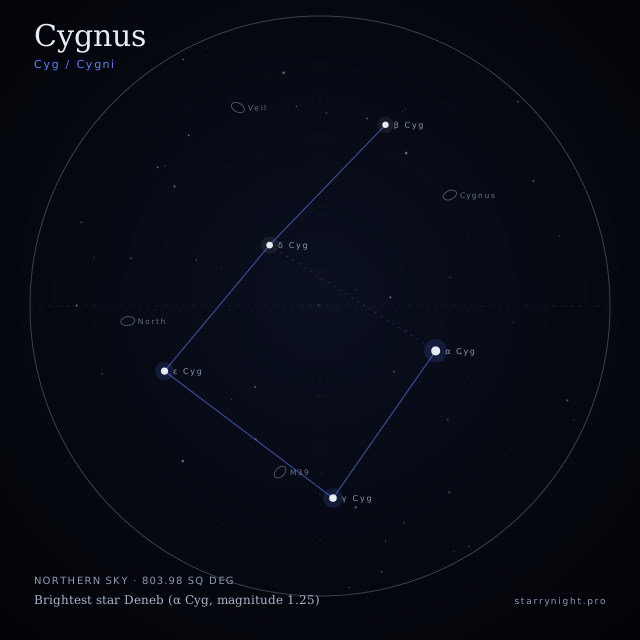
Cygnus spreads across 803.98 square degrees of sky, which places it 16th among the 88 constellations — a genuinely large figure for a constellation most observers know chiefly for one bright star. The area matters practically: the constellation swallows a long stretch of the Milky Way, which is why it holds so many nebulae and clusters rather than a mere scattering of bright stars. Deneb, at magnitude 1.25, is the anchor. Its spectral type A2Ia marks it as a luminous supergiant — the 'Ia' suffix denotes the brightest luminosity class assigned to supergiants — so a star that looks modestly bright to the eye is in fact radiating enormously from a great distance. The naming follows the standard Latin system: the nominative is Cygnus, the swan, and the genitive Cygni is what appears in Bayer designations like α Cygni and in variable-star names. The three-letter abbreviation Cyg is simply clipped from the genitive.
Star-hop to it
Late September evenings are the easiest entry. Face west-northwest after dusk and look for the Summer Triangle, the big asterism whose three corners are Vega in Lyra, Altair in Aquila, and Deneb itself — Vega to Deneb is roughly 24 degrees, about two and a half fist-widths at arm's length. Deneb marks the swan's tail; Sadr, at magnitude 2.23, sits where the body meets the outstretched wings, and the line Deneb–Sadr–Albireo runs down the spine to the beak. From Lyra the hop is trivial: swing from Vega toward the Milky Way's band and Deneb appears as the first bright star embedded in it. Observers above 40°N never lose the constellation, so the month matters less than for southerly skywatchers; from 30°N it skims low but stays useful. Cepheus sits directly north of Deneb, and Pegasus's Great Square lies east, giving two more handles. Watch for the Northern Cross, the same stars read as an upright crucifix in autumn.
Myth and culture
The Greek swan carries several stories at once. Zeus, courting Leda, took the form of a swan; in another telling the constellation is Orpheus, placed in the sky after his death beside his lyre — which is why Lyra borders Cygnus to the west. Arabic star names trace a different bird entirely: Deneb comes from dhanab al-dajājah, the hen's tail, and Albireo's label descends from al-minqar al-dajājah, the hen's beak, mangled through medieval translation. Sadr means 'chest,' Gienah 'wing.' Chinese astronomy read the same stars as 天津, Tianjin, the celestial ford — the crossing point of the Milky Way — with Deneb as its fourth star, 天津四. In the Qixi legend the weaver girl (Vega) and the cowherd (Altair) meet once a year over a bridge of magpies spanning that river; Cygnus supplies the ford where the crossing happens. The Northern Cross shape has also long served European skywatchers as a seasonal marker of autumn.
Deep-sky tour
Start with M39, an open cluster of magnitude 4.6. That figure is integrated light spread over a wide area, so it never looks like a compact glow — about 20 stars loosely arranged in a rough triangle, best framed in binoculars or a low-power eyepiece where the surrounding field gives it context. The North America Nebula, NGC 7000, shares the same problem in reverse: magnitude 4 sounds bright, but it is a huge, low-surface-brightness emission patch. From a genuinely dark site the continent shape is naked-eye; add a UHC filter and the Gulf of Mexico coast snaps into focus. The Veil, NGC 6960 and NGC 6992, is a supernova remnant at magnitude 7, all delicate filaments rather than one object — an OIII filter and a wide field are almost mandatory, and the two arcs reward patience. Finally, Cygnus X-1: the companion star HDE 226868 glows at magnitude 8.9 and is a fair small-telescope target, but the black hole itself is invisible. That asymmetry — a visible star, an undetectable partner — is the whole point.
Catalogue data
| Latin name | Cygnus |
|---|---|
| IAU abbreviation | Cyg |
| Genitive | Cygni |
| Sky zone | Northern sky |
| Best from | 30°N and northward (circumpolar above 40°N) |
| Best month | September |
| Area | 803.98 square degrees |
| Brightest star | Deneb (α Cyg, magnitude 1.25) |
Story & naming
The swan is usually Zeus in disguise, descending on Leda; other tellings make it the mourning friend of Phaethon or the musician Orpheus placed beside his lyre. Whatever the story, the shape is unambiguous: Deneb marks the tail, Albireo the beak, and Sadr the point where the wings cross the body. Deneb is one of the most luminous stars visible to the unaided eye, thousands of light-years away yet still first magnitude.
How to find it
Look overhead on a September evening for the huge cross. Deneb forms the Summer Triangle with Vega in Lyra and Altair in Aquila — find those two bright stars first, then Deneb is the third corner to the north-east. The long axis of the cross runs roughly along the Milky Way, from Albireo up to Deneb.
Main stars
| Star | Designation | Magnitude | Spectral type |
|---|---|---|---|
| Deneb | α Cyg | 1.25 | A2Ia |
| Sadr | γ Cyg | 2.23 | F8Ib |
| Gienah | ε Cyg | 2.48 | K0III |
| Delta Cygni | δ Cyg | 2.86 | B9.5III |
| Albireo | β Cyg | 3.05 | K3II + B8V |
Deep-sky objects
| Object | Type | Magnitude | Note |
|---|---|---|---|
| M39 | Open cluster | 4.6 | Big, loose and obvious in binoculars; about 20 stars in a triangle. |
| North America Nebula (NGC 7000) | Emission nebula | 4 | Naked-eye from a dark site; a UHC filter makes the continent shape jump out. |
| Veil Nebula (NGC 6960/6992) | Supernova remnant | 7 | Delicate filaments that need an OIII filter and a wide field. |
| Cygnus X-1 | Black hole binary | 8.9 (star) | The companion star HDE 226868 is visible; the black hole is not. |
Observing notes
Albireo is the finest colour-contrast double in the sky: a gold primary with a sapphire companion, separable in a 60 mm scope at 30x. The Veil Nebula needs an OIII filter but then unfolds as long ribbons. Nearly the whole constellation sits inside the Milky Way, so a wide-field binocular sweep from Deneb to Albireo will show dozens of star clouds and dark rifts.
Bordering constellations
Note
StarryNight is an informational reference for amateur observers. Nothing here is professional astronomical, navigational or safety advice — always check a current almanac and your local weather before travelling to a dark site.
The same sheet in the other language: 天鹅座 Cygnus