Equatorial band · Ori
Orion, the Hunter
Orion · Orionis
Orion is the only constellation that is genuinely recognisable to almost everybody on Earth, because it straddles the celestial equator and shows the same shape from both hemispheres.
Physical profile
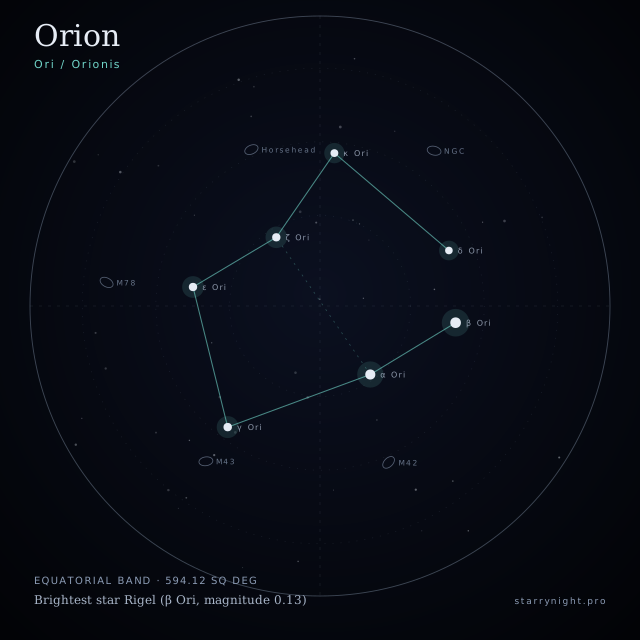
Orion covers 594.12 square degrees of sky, which places it 26th by area among the 88 constellations — roomy enough to swallow the Belt, the Sword and both shoulders with space to spare. Its brightest star, Rigel, glows at magnitude 0.13, a full 0.37 magnitudes ahead of Betelgeuse at 0.5; on a light-polluted street that difference decides which corner of the figure you see first. Rigel's spectral type, B8Ia, is the catalogue's shorthand for a blue-white supergiant, the 'Ia' marking it among the most luminous classes recognised. Betelgeuse's M1-2Ia-ab tells a different story: a cool red supergiant whose spectrum wobbles between normal and slightly peculiar. The naming is Latin. Orion is the nominative form, so the constellation is Orion, and the genitive Orionis is what attaches to star designations — Beta Orionis, Alpha Orionis. Bayer letters run roughly in brightness order inside this figure, which is why Beta outranks Alpha here.
Star-hop to it
January is the month to look: Orion stands on the meridian around local midnight, its three Belt stars — Alnitak at magnitude 1.74, Alnilam at 1.69 and Mintaka at 2.23 — lying almost exactly along the celestial equator, which is why observers between 20°N and 40°N get the cleanest view of the whole figure. Start from Taurus in the northwest: the V of the Hyades and Aldebaran lead the eye down toward the Belt, and the same line carried further on reaches the Pleiades. From the other side, follow the Belt southeast; it delivers you straight to Sirius at magnitude -1.46, the brightest star in the night sky. Gemini lies northeast of the shoulders, so Betelgeuse at 0.5 and Bellatrix at 1.64 act as a divider between the Twins and the hunter's Belt. Below them, Rigel and Saiph mark the knees, Rigel always the brighter and always the northwestern of the pair.
Myth and culture
Greek myth gives the figure its name: Orion, the hunter, who boasted he could clear the earth of every wild animal until a scorpion — set in the sky as Scorpius, rising as Orion sets — finished him. But the star names are largely Arabic, arriving through medieval translation. Betelgeuse descends from a phrase meaning 'hand of the giant', though a copying error turned 'hand' into 'armpit' in some readings. Rigel comes from Rijl Jauza al-Yusra, 'the left foot of the giant'. Alnitak and Mintaka both derive from words for a belt or girdle; Alnilam means 'string of pearls', the same image the Belt suggests to the eye. Saiph is 'the sword of the giant'. In Chinese astronomy these stars belong to Shen, one of the twenty-eight lunar mansions, with Betelgeuse catalogued as the fourth star of Shen. The three Belt stars were known separately as the Three Stars, a marker of midwinter and the new year.
Deep-sky tour
The Sword is where a small telescope earns its keep. M42, the Orion Nebula, sits at magnitude 4 — bright enough for the naked eye from a dark site, which is remarkable for a cloud of gas and dust. Through binoculars the Trapezium cluster resolves at its heart; a 100mm scope at roughly 80x splits the four brightest members and shows darker bays eating into the glow. Just north lies M43, De Mairan's Nebula, magnitude 9, a comma-shaped lobe cut off from M42 by a dark lane — fainter, and best on a moonless night. Further north, M78 at magnitude 8.3 is the sky's brightest reflection nebula, two blue-white stars lighting the dust that reflects their light; it appears as a soft bluish patch. The Horsehead Nebula carries no listed magnitude at all — it is a dark silhouette needing a hydrogen-beta filter and genuinely dark skies. Finally NGC 2169, an open cluster at magnitude 5.9, whose two clumps of stars spell out a rough '37'.
Catalogue data
| Latin name | Orion |
|---|---|
| IAU abbreviation | Ori |
| Genitive | Orionis |
| Sky zone | Equatorial band |
| Best from | Both hemispheres; best from 20°N–40°N |
| Best month | January |
| Area | 594.12 square degrees |
| Brightest star | Rigel (β Ori, magnitude 0.13) |
Story & naming
Orion was a giant hunter who boasted he could kill every animal on earth; Gaia sent a scorpion to sting him, and both were placed in the sky at opposite ends so they never meet. The figure is drawn with a club raised in one hand and a shield or lion skin in the other. Its three belt stars, Alnitak, Alnilam and Mintaka, hang almost exactly on the celestial equator — which is why they rise due east and set due west anywhere on the planet.
How to find it
Look for the three evenly spaced belt stars first; nothing else in the sky looks quite like them. Below and to the right of the belt (from the northern hemisphere) is Rigel, brilliant and blue-white; above and to the left is Betelgeuse, distinctly orange and noticeably dimmer than it used to be. The belt points south-east toward Sirius and north-west toward Aldebaran, which makes it the best signpost in the winter sky.
Main stars
| Star | Designation | Magnitude | Spectral type |
|---|---|---|---|
| Rigel | β Ori | 0.13 | B8Ia |
| Betelgeuse | α Ori | 0.5 | M1-2Ia-ab |
| Bellatrix | γ Ori | 1.64 | B2III |
| Alnilam | ε Ori | 1.69 | B0Ia |
| Alnitak | ζ Ori | 1.74 | O9.7Ib |
| Saiph | κ Ori | 2.07 | B0.5Ia |
| Mintaka | δ Ori | 2.23 | O9.5II |
Deep-sky objects
| Object | Type | Magnitude | Note |
|---|---|---|---|
| M42 Orion Nebula | Emission nebula | 4 | Naked-eye from a dark site; the Trapezium cluster sits at its heart. |
| M43 De Mairan's Nebula | Emission nebula | 9 | A small comma-shaped extension north of M42, cut off by a dark lane. |
| M78 | Reflection nebula | 8.3 | Two blue-white stars light up the brightest reflection nebula in the sky. |
| Horsehead Nebula (B33) | Dark nebula | — | Needs a hydrogen-beta filter and a dark site; the silhouette is faint. |
| NGC 2169 | Open cluster | 5.9 | Its two groups of stars form a pattern that looks like the number 37. |
Observing notes
M42 is rewarding at every aperture: 60 mm shows the Trapezium as four separate stars, and a 200 mm scope reveals the nebula's full wing shape extending past the field of view. Betelgeuse is a red supergiant whose brightness varies unpredictably between about magnitude 0.0 and 1.3 — it underwent a historic deep fade in 2019-2020 when dust obscured it. Orion also contains a huge faint molecular cloud complex; through binoculars the region around Alnitak is full of nebulosity and dark lanes.
Bordering constellations
Note
StarryNight is an informational reference for amateur observers. Nothing here is professional astronomical, navigational or safety advice — always check a current almanac and your local weather before travelling to a dark site.
The same sheet in the other language: 猎户座 Orion