Zodiacal road · Tau
Taurus, the Bull
Taurus · Tauri
Taurus carries two of the most famous star groups in the sky — the Pleiades and the Hyades — which means it gets more naked-eye attention than almost any other constellation.
Physical profile
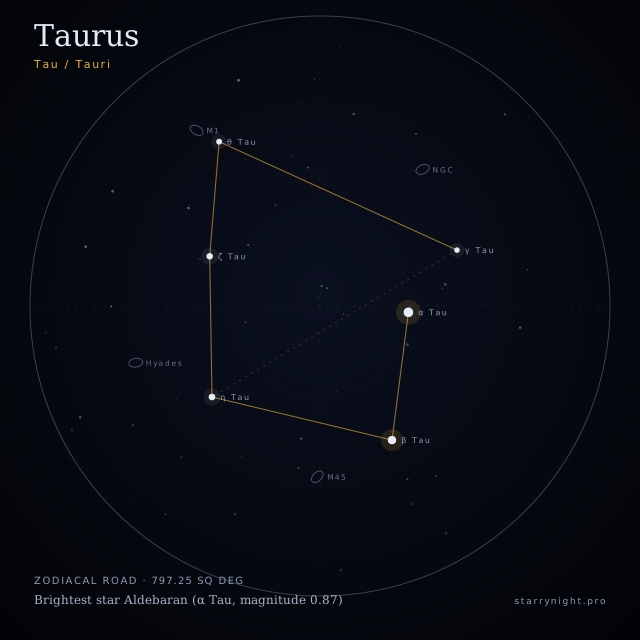
Taurus spans 797.25 square degrees of sky, a substantial share of the celestial sphere and one of the 88 official constellations. Its size means it crosses a wide swath of the winter sky, carrying both the V-shaped Hyades and the compact Pleiades within its borders. The brightest star, Aldebaran, shines at magnitude 0.87 with spectral type K5III. That combination—zero-point-eight-seven, K5, III—identifies an orange giant: cooler than the Sun but far more luminous, a star that has left the main sequence. Elnath, at magnitude 1.65 and B7III, is a blue giant, so Taurus contrasts cool and hot evolved stars. The naming is Latin: nominative Taurus, genitive Tauri. Astronomers write Aldebaran as α Tauri, not α Taurus; the genitive fixes every Bayer designation, and the abbreviation Tau follows. Because Taurus is zodiacal, the Sun, Moon, and planets pass through it, which is why its boundaries matter in both mythology and positional astronomy.
Star-hop to it
Start with Orion, the most reliable signpost. In January, from 40°N, Taurus culminates near the meridian during mid-evening, so the route works when Orion is already prominent. Follow the three Belt stars northwest, away from Sirius, and the line reaches Aldebaran after roughly 20 degrees. Aldebaran, the Bull's eye, marks one vertex of the Hyades V. From Aldebaran, continue the same northwest line about 14 degrees to the Pleiades. Alternatively, use Auriga: bright Capella anchors that pentagon, and Elnath, the Bull's northern horn tip, sits at Auriga's southern edge; look south from Capella to Elnath, then southwest to the Hyades. From Aries, face east; the Pleiades appear as a small misty dipper, and the Hyades lie farther east. From Perseus, follow the main chain southward; it leads toward Elnath and the horns. Cetus and Eridanus lie south and southwest, but they are lower and less useful from 40°N; use them only when Orion is obscured.
Myth and culture
Greek myth makes Taurus the bull into which Zeus transformed to abduct Europa, carrying her across the sea to Crete; the animal’s front half is usually drawn in the stars, with the Pleiades on its shoulder and the Hyades forming its face. The name is Latin for bull, and the genitive Tauri preserves that identity in catalogue labels. Arabic sky lore gives the constellation some of its most familiar star names. Aldebaran comes from al-dabarān, “the follower,” because it trails the Pleiades as they rise and set. Elnath derives from al-nath, linked to butting or goring, fitting the Bull’s horn tip. In Chinese astronomy, the Pleiades form Mao, one of the 28 lunar mansions, while the Hyades belong to Bi, another mansion, so Taurus was not one bull but a set of asterisms tied to calendrical and ceremonial sky-watching. That layered naming—Greek beast, Arabic follower, Chinese mansion—shows how one patch of sky can carry unrelated stories.
Deep-sky tour
M45, the Pleiades, is the showpiece: an open cluster at magnitude 1.6, bright enough to be obvious to the unaided eye as a tiny dipper of mist. Its listed note says the finest naked-eye cluster, and that is accurate—hundreds of stars appear in a wide-field scope, so use the lowest power and widest eyepiece you own. The Hyades, magnitude 0.5, is even brighter but far more scattered; it forms the V of the Bull’s face and is the nearest open cluster to Earth at 153 light-years. Binoculars suit it better than a telescope because its stars spill across several degrees. M1, the Crab Nebula, is a supernova remnant at magnitude 8.4, the leftover of the supernova recorded in 1054 AD. Small telescopes show only a faint oval smudge, requiring dark skies and averted vision. NGC 1647, magnitude 6.4, is a big loose cluster 3.5 degrees north-east of Aldebaran; low power reveals its scattered stars.
Catalogue data
| Latin name | Taurus |
|---|---|
| IAU abbreviation | Tau |
| Genitive | Tauri |
| Sky zone | Zodiacal road |
| Best from | Both hemispheres; best from 40°N |
| Best month | January |
| Area | 797.25 square degrees |
| Brightest star | Aldebaran (α Tau, magnitude 0.87) |
Story & naming
The bull is Zeus in another disguise, this time carrying Europa across the sea. Only the front half of the animal is drawn, rising out of the water: the V-shaped Hyades form the face, Aldebaran is the eye, and the two long horns end at Elnath and Zeta Tauri. The Pleiades, perched on the bull's shoulder, were a separate object of veneration in Greek and many other cultures long before they were attached to the animal.
How to find it
In winter, follow the three belt stars of Orion up and to the right; the first bright orange star you meet is Aldebaran, with the V of the Hyades around it. Continue the same line past the V and you run into the Pleiades, a tight knot of stars that looks like a miniature dipper. The two horns stretch on past Elnath, which is shared with Auriga.
Main stars
| Star | Designation | Magnitude | Spectral type |
|---|---|---|---|
| Aldebaran | α Tau | 0.87 | K5III |
| Elnath | β Tau | 1.65 | B7III |
| Alcyone | η Tau | 2.87 | B7IIIe |
| Zeta Tauri | ζ Tau | 3 | B2IIIpe |
| Theta Tauri | θ Tau | 3.4 | A7III |
| Gamma Tauri | γ Tau | 3.65 | G8III |
Deep-sky objects
| Object | Type | Magnitude | Note |
|---|---|---|---|
| M45 Pleiades | Open cluster | 1.6 | The finest naked-eye cluster; hundreds of stars in a wide-field scope. |
| Hyades | Open cluster | 0.5 | The V of the bull's face — the nearest open cluster to Earth at 153 light-years. |
| M1 Crab Nebula | Supernova remnant | 8.4 | The remnant of the supernova recorded in 1054 AD; a faint oval smudge. |
| NGC 1647 | Open cluster | 6.4 | Big loose cluster 3.5 degrees north-east of Aldebaran. |
Observing notes
The Pleiades are best in binoculars or a very low-power wide field — any telescope that magnifies beyond about 30x will swallow only part of the cluster. Count how many Pleiads you can see with the naked eye as a standard seeing test; six is average, nine is excellent. M1 is a genuine challenge object, requiring dark skies and at least 150 mm of aperture, and the pulsar at its centre spins 30 times a second.
Bordering constellations
Note
StarryNight is an informational reference for amateur observers. Nothing here is professional astronomical, navigational or safety advice — always check a current almanac and your local weather before travelling to a dark site.
The same sheet in the other language: 金牛座 Taurus