Northern sky · Peg
Pegasus, the Winged Horse
Pegasus · Pegasi
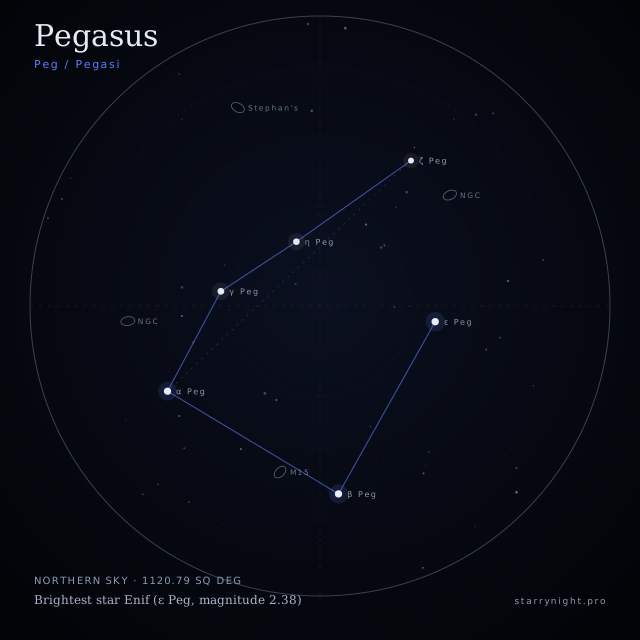
Pegasus is best known for the Great Square — four stars marking the horse's body, with only the head and forelegs drawn in. The hindquarters were cut away to make room for Andromeda.
Physical profile
Pegasus covers 1120.79 square degrees, which puts it among the largest of the 88 constellations — big enough that its Great Square of four stars serves as a seasonal landmark rather than a small pattern. Its brightest star, Enif, reaches only magnitude 2.38, so Pegasus holds no first-magnitude beacon; every listed star sits between 2.38 and 3.4. Enif's K2Ib-II spectral type marks it as an orange supergiant or bright giant, cool in temperature but enormously luminous and far larger than the Sun. Markab (B9III, magnitude 2.48) and Algenib (B2IV, 2.83) are hot blue-white objects, while Scheat (M2.5II-III, 2.42) is a red giant. That spread of B, K and M types gives the constellation a visible range of colour. Matar, at 2.94 and type G2II-III, is a yellow bright giant, and Homam closes the list at magnitude 3.4. The genitive 'Pegasi' supplies the second half of designations such as Alpha Pegasi, while the IAU's three-letter code 'Peg' replaces the full name in catalogues.
Star-hop to it
October evenings are the best time: for observers at 20°N and anywhere north of that, the Great Square stands high in the south soon after dark. Begin with Andromeda — its star Alpheratz is the square's northeast corner, stitching the two constellations together. The other three corners are Algenib at the southeast, Markab at the southwest, and Scheat at the northwest, four stars between magnitude 2.4 and 2.8 that draw the horse's body. Coming from Cygnus, follow the long axis of the Northern Cross eastward and you run straight into the square. To pick out the head, leave Markab and drop about 20 degrees southwest to Enif, the muzzle and the brightest star here. Matar (2.94) and Homam (3.4) mark the neck and foreleg closer to the square. M15 sits a short hop west-northwest of Enif.
Myth and culture
Pegasus is the winged horse of Greek myth, born when Perseus cut off Medusa's head and her blood fell into the sea. Bellerophon tamed the horse with a golden bridle and rode it against the Chimera, but when he tried to fly to Olympus he was thrown, and Pegasus went on to carry Zeus's thunderbolts. A hoof-strike on Mount Helicon opened the spring Hippocrene, whose waters were said to inspire poets. Arabic star names tell a different story. Markab means 'the saddle', and Enif comes from 'anf', 'the nose' — the horse's muzzle. Matar and Homam belong to the old Arabian 'Sa'd' series of lucky stars; Matar means 'rain', Homam 'the high-minded hero'. Chinese astronomers split the Great Square between two lunar mansions: Markab and Scheat formed Shì, the Encampment, while Algenib and Andromeda's Alpheratz formed Bì, the Wall.
Deep-sky tour
Four targets repay the trip. M15, at magnitude 6.2, is the easiest: binoculars under a dark sky show it as a fuzzy star, and a 150 mm telescope reveals a grainy halo around a core that refuses to break apart — M15 is among the most concentrated globular clusters known, so its centre stays a dense knot. NGC 7331, magnitude 9.5, is a spiral often called a twin of the Milky Way; a 150 mm scope shows an elongated, tilted glow with a brighter middle, and larger apertures begin to hint at structure. Stephan's Quintet, magnitude 13.6, sits near NGC 7331; four of its five members physically interact, but the group is a genuine challenge that asks for a 300 mm telescope and a dark site. NGC 7479, the Propeller Galaxy at magnitude 10.9, is a barred spiral whose long, asymmetric bar throws off arms sweeping opposite ways — a 200 mm scope catches the bar, the spiral shape needs more.
Catalogue data
| Latin name | Pegasus |
|---|---|
| IAU abbreviation | Peg |
| Genitive | Pegasi |
| Sky zone | Northern sky |
| Best from | 20°N and northward |
| Best month | October |
| Area | 1120.79 square degrees |
| Brightest star | Enif (ε Peg, magnitude 2.38) |
Story & naming
The winged horse sprang from the blood of Medusa when Perseus cut off her head, and later carried Bellerophon in his fight against the Chimera. When Bellerophon tried to fly to Mount Olympus, Zeus sent a gadfly to throw him, and Pegasus went on alone to carry the thunderbolts. The constellation's Arabic star names are unusually visual: Markab is "the saddle", Scheat "the shin", Enif "the nose" of the horse.
How to find it
In autumn the Great Square stands high in the east — four stars of similar brightness forming a box about 15 degrees across. One corner, Alpheratz, is officially in Andromeda, which is why the square belongs to two constellations at once. The horse's neck and head trail off to the west of the square, ending at Enif.
Main stars
| Star | Designation | Magnitude | Spectral type |
|---|---|---|---|
| Enif | ε Peg | 2.38 | K2Ib-II |
| Scheat | β Peg | 2.42 | M2.5II-III |
| Markab | α Peg | 2.48 | B9III |
| Algenib | γ Peg | 2.83 | B2IV |
| Matar | η Peg | 2.94 | G2II-III |
| Homam | ζ Peg | 3.4 | B8.5V |
Deep-sky objects
| Object | Type | Magnitude | Note |
|---|---|---|---|
| M15 | Globular cluster | 6.2 | Extremely dense core — one of the most concentrated globulars known. |
| NGC 7331 | Spiral galaxy (Sb) | 9.5 | Often called a twin of the Milky Way; small and bright enough for a 150 mm scope. |
| Stephan's Quintet (HCG 92) | Galaxy group | 13.6 | Four of the five members physically interact; a challenge for 300 mm. |
| NGC 7479 Propeller Galaxy | Barred spiral (SBc) | 10.9 | A long, asymmetric bar with arms sweeping opposite ways. |
Observing notes
M15 is a fine globular for small scopes: bright, compact and easy to star-hop from Enif. NGC 7331 to the north of the square looks much like a smaller version of our own galaxy seen at an angle. The square itself is useful as a rough sky-brightness gauge — count how many faint stars you can pick out inside it on a given night.
Bordering constellations
Note
StarryNight is an informational reference for amateur observers. Nothing here is professional astronomical, navigational or safety advice — always check a current almanac and your local weather before travelling to a dark site.
The same sheet in the other language: 飞马座 Pegasus