Northern sky · Lyr
Lyra, the Lyre
Lyra · Lyrae
Lyra is small and bright: a neat parallelogram of stars hanging from Vega, the fifth-brightest star in the night sky and the anchor of the Summer Triangle.
Physical profile
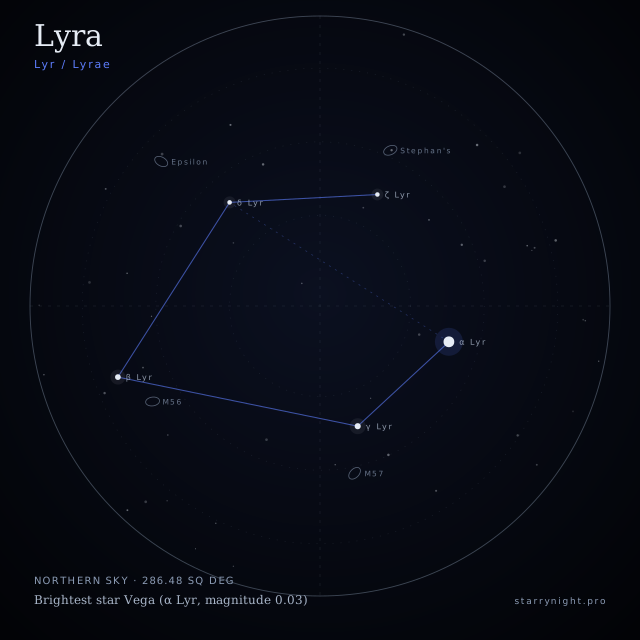
Lyra covers 286.48 square degrees, roughly seven-tenths of one percent of the celestial sphere, a middling figure among the 88 constellations. It is not a sprawling giant, and it is not a scrap of sky either, yet its area is packed with landmarks rather than empty ground. Vega anchors the figure at magnitude 0.03, within a hair of zero and among the brightest stars in the night sky. Its spectral type, A0Va, is specific: a white, hydrogen-fusing main-sequence star, the "V" marking a dwarf rather than an evolved giant like Sheliak, whose B8IIpe label describes a far larger and more luminous body. Sulafat, at 3.25, and Sheliak, at 3.52, are the constellation's other named lights, both noticeably fainter than Vega. The naming follows Latin convention: the constellation is Lyra, and objects inside it take the genitive Lyrae, so the brightest star is α Lyrae and the Ring Nebula is recorded in Lyrae's borders.
Star-hop to it
Finding Lyra is mostly a matter of finding Vega, and Vega is difficult to miss. At a declination near +39°, it passes almost directly overhead for an observer at 40°N and remains above the horizon through the night in summer. The easiest route is the Summer Triangle, the huge asterism formed by Vega, Deneb in Cygnus and Altair in Aquila; three bright stars, no chart required. Vega is the brightest of the three, so seeing the triangle at all means you have already located Lyra's anchor. From Cygnus, run down the Swan's spine from Deneb toward Albireo and look west of it; from Hercules, take the Keystone, the four-star trapezoid at the centre, and follow its northern corner outward. Draco coils around the north side and its head sits off to the northeast, a useful check on direction. By August the whole figure stands near the meridian, the small parallelogram hanging below Vega, with Vega, Zeta and Epsilon Lyrae forming a compact triangle at the northern tip.
Myth and culture
The lyre in the sky belongs to Orpheus, the musician whose playing calmed animals, stopped rivers and persuaded Hades to release Eurydice — until he looked back. After his death, the story goes, the instrument was set among the stars; Hermes had built the first lyre from a tortoise shell and passed it to Apollo, who gave it to Orpheus, which is why Lyra is small, curved and made of very few bright stars. Arabic tradition read the same group as an eagle: Vega's name comes from al-nasr al-wāqiʿ, "the swooping eagle," while Altair in Aquila is the flying eagle and Deneb the tail. Sulafat, the gamma star, carries the Arabic al-sulḥafāt, "the tortoises," a direct nod to the shell; Sheliak descends from al-shilyāq. In China, Vega is Zhīnǚ, the Weaving Girl, separated from the Cowherd, Altair, by the River of Heaven — the Milky Way — and allowed to meet him only on the seventh night of the seventh lunar month, the Qixi festival.
Deep-sky tour
Deep-sky work in Lyra starts with M57, the Ring Nebula, listed at magnitude 8.8. That number flatters a planetary nebula, because the light spreads across a disc rather than concentrating in a point; a 150 mm telescope at high power is what finally shows the darker centre, the hollow that earns the object its smoke-ring nickname. At low magnification it is easily mistaken for a slightly fuzzy star, so push the power and the ring appears. M56 is the opposite problem: a globular cluster at magnitude 8.3, loose and faint, sitting roughly halfway between Sulafat and Albireo, it stays a dim unresolved glow in small apertures. Epsilon Lyrae rewards patience — combined at magnitude 4.7, it splits into two pairs near 100x, and each pair then needs 200x and steady air to break apart. Stephan's Quintet, magnitude 13.6, is effectively a photographic object: a tight group of five galaxies whose integrated light barely registers, and which a small telescope will show as nothing at all, or as the faintest smudge under genuinely dark skies.
Catalogue data
| Latin name | Lyra |
|---|---|
| IAU abbreviation | Lyr |
| Genitive | Lyrae |
| Sky zone | Northern sky |
| Best from | 40°N and northward |
| Best month | August |
| Area | 286.48 square degrees |
| Brightest star | Vega (α Lyr, magnitude 0.03) |
Story & naming
The lyre belonged to Orpheus, whose playing could stop rivers and soften stones. After his death the instrument was placed among the stars beside the swan. Vega's name comes from the Arabic an-nasr al-wāqiʿ, "the swooping eagle", a leftover from a time when the constellation was drawn as a bird rather than an instrument. Vega was also the first star ever photographed, in 1850.
How to find it
Vega is unmistakable: brilliant blue-white, nearly overhead on an August evening at mid-northern latitudes. The rest of the constellation is the small parallelogram just to its south-east, formed by Sheliak, Sulafat, Delta and Zeta Lyrae. Vega is roughly midway between the two stars of the parallelogram's long side.
Main stars
| Star | Designation | Magnitude | Spectral type |
|---|---|---|---|
| Vega | α Lyr | 0.03 | A0Va |
| Sulafat | γ Lyr | 3.25 | B9III |
| Sheliak | β Lyr | 3.52 | B8IIpe |
| Delta Lyrae | δ Lyr | 4.3 | M4II |
| Zeta Lyrae | ζ Lyr | 4.36 | Am |
Deep-sky objects
| Object | Type | Magnitude | Note |
|---|---|---|---|
| M57 Ring Nebula | Planetary nebula | 8.8 | The classic smoke ring; a 150 mm scope at high power shows the darker centre. |
| M56 | Globular cluster | 8.3 | Loose and faint, halfway between Sulafat and Albireo. |
| Epsilon Lyrae | Double-double | 4.7 combined | Splits into two pairs at 100x; each pair needs 200x and steady air. |
| Stephan's Quintet (HCG 92) | Galaxy group | 13.6 | Tight group of five; the famous image target, extremely faint visually. |
Observing notes
M57 sits between Sheliak and Sulafat and is the best planetary nebula for a first look — visible in a 60 mm scope as a small grey oval, and as a ring at 100x and above. Epsilon Lyrae, just north-east of Vega, is the famous "Double Double": two pairs, each needing high magnification on a night of steady air. Vega also serves as the zero point of the old magnitude scale.
Bordering constellations
Note
StarryNight is an informational reference for amateur observers. Nothing here is professional astronomical, navigational or safety advice — always check a current almanac and your local weather before travelling to a dark site.
The same sheet in the other language: 天琴座 Lyra