Northern sky · Her
Hercules, the Strongman
Hercules · Herculis
Hercules is a large but faint constellation — four stars forming the Keystone at its centre, with the rest of the hero's body drawn in third- and fourth-magnitude stars.
Physical profile
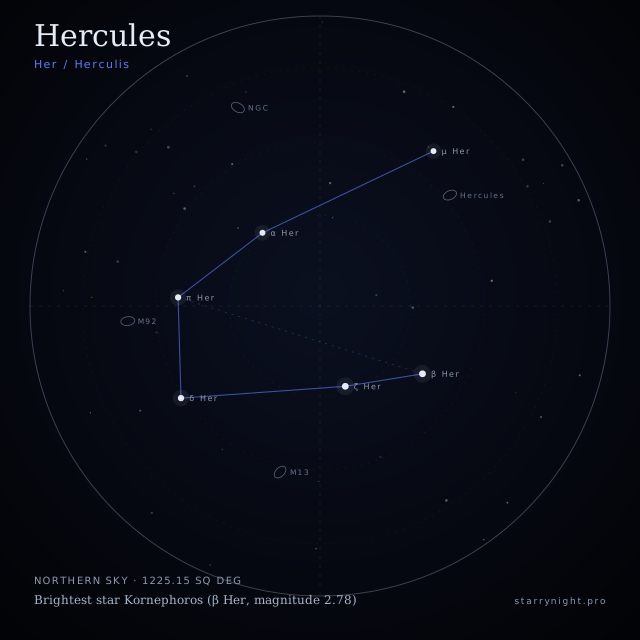
Hercules spreads across 1225.15 square degrees, making it the fifth-largest of the 88 constellations — big enough that its four-cornered Keystone asterism sits well clear of its own borders. Size, though, buys nothing in brightness. The brightest star, Kornephoros (β Herculis), glows at magnitude 2.78 and carries the spectral type G7IIIa: the Roman numeral III marks it as a giant, a star that has swollen off the main sequence, and the trailing 'a' notes a slightly peculiar spectrum. Zeta Herculis (magnitude 2.81) trails by three hundredths of a magnitude, a hairline gap that makes the ranking of 'brightest' almost nominal. That the leader is Beta, not Alpha, is a reminder that Bayer's Greek letters were assigned by position, not by light. Every formal name takes the genitive: α Herculis, β Herculis — Herculis, not Hercules, is what follows the letter in a catalogue.
Star-hop to it
Find Hercules by parking it between two brilliant anchors. From mid-northern latitudes — the constellation is circumpolar or high for most observers at 30°N and northward — look for Arcturus in Boötes and Vega in Lyra; the Keystone, a squashed quadrilateral of four stars, sits roughly midway on the line joining them. That asterism is your map: its corners are Zeta, Epsilon, Pi and Eta Herculis, and Pi Herculis at magnitude 3.16 marks the northern edge. July evenings put the whole figure near the meridian, with the head-down hero sprawling south of the Keystone. Corona Borealis, the little semicircle, tucks in just west of the Keystone's western corner, and Draco wraps the northern side. From Ophiuchus or Serpens Caput to the south, sweep north until the quadrilateral snaps into view. Rasalgethi, the magnitude 3.35 star, sits in the southern part of the figure and offers the constellation's easiest colour test — a distinctly ruddy point against the Keystone's white.
Myth and culture
Hercules is the Latinized Heracles, the strongest of Greek heroes, set in the sky after his twelve labours. Yet the older Greek name for this patch was simply Engonasin, 'the Kneeler' — a faceless figure crouching, one knee down, which is how the stars still look if you connect them honestly. Rasalgethi, Alpha Herculis, preserves that older picture in Arabic: ra's al-jāthī, 'the head of the kneeler.' Kornephoros, the brightest star, comes from Greek for 'club-bearer,' the weapon the hero raises above his head. In Chinese astronomy these stars were no hero at all; they fed into the Heavenly Market Enclosure, Tian Shi Yuan, a walled celestial marketplace whose two boundary walls were drawn across Hercules, Ophiuchus and neighbouring figures. One sky, three entirely different stories — a kneeling strongman, a club-wielding hero, and the boundary posts of a celestial bazaar.
Deep-sky tour
Start with M13, the Great Globular Cluster, glowing at magnitude 5.8 — bright enough that a keen-eyed observer under dark skies catches it naked-eye as a fuzzy star just off the Keystone's western edge. Binoculars show a comet-like smudge; a 150 mm telescope begins to resolve the outer edge into a swarm of individual suns. Roughly 300,000 stars are packed inside. M92, magnitude 6.3, lies north of the Keystone and is almost as fine, with a tighter, brighter core — a compact ball far less visited than its famous neighbour, and the better test of a small instrument's resolution. NGC 6210, the Turtle Nebula, is a planetary at magnitude 8.8: expect a tiny blue-green disc, stellar at low power, and only at high magnification does any shape appear — a faint shell that earned the nickname. Then Abell 2151, the Hercules Cluster, at magnitude 13: a rich swarm of spiral galaxies 400 million light-years away. Through a small telescope it is barely a scatter of faint blurs; photographically, it opens into structure.
Catalogue data
| Latin name | Hercules |
|---|---|
| IAU abbreviation | Her |
| Genitive | Herculis |
| Sky zone | Northern sky |
| Best from | 30°N and northward |
| Best month | July |
| Area | 1225.15 square degrees |
| Brightest star | Kornephoros (β Her, magnitude 2.78) |
Story & naming
The Greeks placed Heracles in the sky after his twelve labours, kneeling with one foot on Draco's head. The star Rasalgethi, "the kneeler's head", is the hero's head; the Keystone is his torso. The constellation is unusual in showing a figure upside down relative to the neighbouring constellations, kneeling toward the north pole as if exhausted.
How to find it
The Keystone — four stars forming a slightly squashed square — sits between Vega and Arcturus, roughly a third of the way from Corona Borealis toward Lyra. Once you have found the Keystone, M13 lies on the western side of the line between Eta and Zeta Herculis, about a third of the way from Eta.
Main stars
| Star | Designation | Magnitude | Spectral type |
|---|---|---|---|
| Kornephoros | β Her | 2.78 | G7IIIa |
| Zeta Herculis | ζ Her | 2.81 | F9IV + G7V |
| Sarin | δ Her | 3.12 | A3IV |
| Pi Herculis | π Her | 3.16 | K3II |
| Rasalgethi | α Her | 3.35 | M5Ib-II |
| Mu Herculis | μ Her | 3.42 | G5IV |
Deep-sky objects
| Object | Type | Magnitude | Note |
|---|---|---|---|
| M13 Great Globular Cluster | Globular cluster | 5.8 | Around 300,000 stars; a 150 mm scope starts to resolve the outer edge. |
| M92 | Globular cluster | 6.3 | Nearly as good as M13 and far less visited — a compact, bright core. |
| NGC 6210 Turtle Nebula | Planetary nebula | 8.8 | Small blue-green disc; high magnification is needed to see any shape. |
| Hercules Cluster (Abell 2151) | Galaxy cluster | 13 | Rich cluster of spirals; a photographic target at 400 million light-years. |
Observing notes
M13 is the showpiece: from a dark site it is a naked-eye smudge, and a 200 mm telescope at 150x begins to break the outer halo into individual stars. Rasalgethi is one of the finest red-and-green doubles in the sky, with a marked colour contrast that shows even in small instruments. M92 sits 6 degrees north and is often skipped, which is a shame — many observers think its core is more tightly packed than M13's.
Bordering constellations
- Draco
- Bootes
- Corona Borealis
- Serpens Caput
- Ophiuchus
- Aquila
- Sagitta
- Vulpecula
- Lyra
Note
StarryNight is an informational reference for amateur observers. Nothing here is professional astronomical, navigational or safety advice — always check a current almanac and your local weather before travelling to a dark site.
The same sheet in the other language: 武仙座 Hercules