Northern sky · UMa
Ursa Major, the Great Bear
Ursa Major · Ursae Majoris
Ursa Major is the third-largest constellation and the one most people can actually find, because its seven brightest stars form the Big Dipper — an asterism that works as a signpost to half the northern sky.
Physical profile
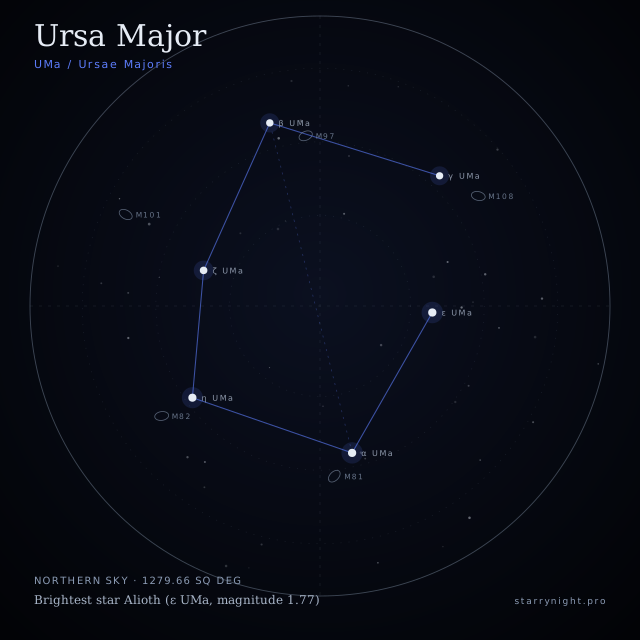
Ursa Major covers 1,279.66 square degrees, which makes it the third-largest of the 88 constellations — only Hydra and Virgo spread wider. That area matters practically: the seven bright stars of the Dipper fit inside a single binocular field, and the constellation's sprawl means its best month, April, finds the Bear highest in the evening sky for northern observers. Alioth, at magnitude 1.77, is the brightest of the six main stars listed — but only just. Dubhe trails at 1.79, and Alkaid at 1.86 is close enough that the trio reads as a near-tie to the eye. Alioth's spectral class, A1III-IVp, describes a white star swelling off the main sequence toward giant status, with the 'p' flagging peculiar abundances of metals. Note that Bayer's letters ignore brightness here: alpha (Dubhe) is not the brightest. In Latin, Ursa Major is 'the Greater Bear'; its genitive, Ursae Majoris, supplies forms like 'Alpha Ursae Majoris' — the possessive used in catalogues and charts.
Star-hop to it
Start with the Dipper itself — it is the shortest route. From mid-northern latitudes the seven stars stand high through spring evenings; above 50°N they never set at all, circling Polaris year-round. In April, look north after twilight and the bowl swings upward. A reliable approach runs from Bootes. Find Arcturus, the orange beacon south of the Dipper's handle, then follow the curve of the handle outward: Alkaid is the last star on that arc. Reverse the trick and the handle's bend leads your eye back down to Arcturus. From the other neighbours, Leo Minor and Canes Venatici sit between Leo and the Bear's paws — sweep north from Leo's sickle in April and you meet the Dipper's bowl. Camelopardalis and Draco fill the region toward the pole, so a line drawn from Polaris through Draco's head eventually crosses into Ursa Major's feet. At 40°N the whole figure clears the northern horizon comfortably; the farther north you live, the more of it stays up.
Myth and culture
The Greek story binds Ursa Major to Callisto, a nymph of Artemis. Zeus loved her; Hera, enraged, turned her into a bear, and when her son Arcas nearly speared her on a hunt, Zeus placed both in the sky — Callisto as the Great Bear, Arcas as Bootes, the herdsman who follows her around the pole. Arabic tradition left the deeper mark on the map. Dubhe comes from dubb, 'bear'; Merak means 'the loins'; Phecda, 'the thigh'; Alkaid, 'the leader' — of the mourning women who trailed the bier, an image the Dipper's three handle stars once carried. Mizar derives from miʾzar, 'apron' or 'waistcloth.' In China the same seven stars formed Beidou, the Northern Dipper, a celestial clock whose handle's direction told the seasons and the hour, and an imperial chariot wheeling around the pole. For enslaved people in the American South, the Dipper was the Drinking Gourd, its pointer stars a guide north toward freedom.
Deep-sky tour
Begin with the pair that shares one low-power field. M81, Bode's Galaxy, glows at magnitude 6.9 — a large, bright oval whose spiral structure hints at shape under dark skies. M82, the Cigar, is dimmer at 8.4 but easier to recognize: an edge-on streak, mottled and uneven, its starburst core driving the strange spectrum that made it famous. M101, the Pinwheel, is the trap. At magnitude 7.9 it sounds brighter than M82, yet its light spreads across a face-on disc, so surface brightness, not aperture, is the problem — save it for a moonless rural night. M97, the Owl Nebula, is a 9.9 planetary, a round grey disc; the two darker patches that give it eyes generally need about 250 mm of aperture to resolve. Finally, M108, the Surfboard, is a thin magnitude-10 streak lying only 48 arcminutes from M97 — nudge your scope and you can catch both nebula and galaxy in the same eyepiece.
Catalogue data
| Latin name | Ursa Major |
|---|---|
| IAU abbreviation | UMa |
| Genitive | Ursae Majoris |
| Sky zone | Northern sky |
| Best from | 40°N and northward (circumpolar above 50°N) |
| Best month | April |
| Area | 1279.66 square degrees |
| Brightest star | Alioth (ε UMa, magnitude 1.77) |
Story & naming
Greek tradition made the bear a transformed Callisto, punished by Hera and thrown into the sky by Zeus; later versions added her son Arcas as Bootes, the herdsman who follows her around the pole. The Dipper itself is not a constellation but a pattern inside one — the bear's tail and hindquarters. Alkaid, Mizar and Alioth mark the handle; Dubhe and Merak mark the bowl. Because the bear's paws stretch far to the south, the full figure covers more sky than the Dipper suggests, and the two stars at the outer rim of the bowl point almost exactly at Polaris.
How to find it
Face north on an April evening and look for the seven-star ladle standing handle-up. Follow the two stars at the outer edge of the bowl — Dubhe and Merak — five times their separation upward and you land on Polaris, which fixes north for the rest of the night. From the handle, arc onward to Arcturus and then down to Spica for the classic "arc to Arcturus, speed on to Spica" star-hop.
Main stars
| Star | Designation | Magnitude | Spectral type |
|---|---|---|---|
| Alioth | ε UMa | 1.77 | A1III-IVp |
| Dubhe | α UMa | 1.79 | K0III |
| Alkaid | η UMa | 1.86 | B3V |
| Mizar | ζ UMa | 2.23 | A2Vp |
| Merak | β UMa | 2.37 | A1V |
| Phecda | γ UMa | 2.44 | A0Ve |
Deep-sky objects
| Object | Type | Magnitude | Note |
|---|---|---|---|
| M81 Bode's Galaxy | Spiral galaxy (Sb) | 6.9 | Large, bright oval; pairs with M82 in the same low-power field. |
| M82 Cigar Galaxy | Starburst galaxy (I0) | 8.4 | Edge-on and mottled; a starburst core drives its unusual spectrum. |
| M101 Pinwheel Galaxy | Face-on spiral (Sc) | 7.9 | Low surface brightness — needs a dark site more than aperture. |
| M97 Owl Nebula | Planetary nebula | 9.9 | Round grey disc; the two dark "eyes" need roughly 250 mm of aperture. |
| M108 Surfboard Galaxy | Edge-on spiral (SBc) | 10 | A thin streak 48 arcminutes from M97 — a good star-hop pair. |
Observing notes
Mizar and Alcor split in almost any binocular; the pair is a traditional eyesight test. M81 and M82 fit together in a 2-degree field and are the easiest external galaxies for small telescopes in the north. Watch Alioth in late spring: the whole Dipper slowly rotates anticlockwise around the pole, so photographing it once an hour gives a clean star-trail fan.
Bordering constellations
Note
StarryNight is an informational reference for amateur observers. Nothing here is professional astronomical, navigational or safety advice — always check a current almanac and your local weather before travelling to a dark site.
The same sheet in the other language: 大熊座 Ursa Major