Northern sky · Dra
Draco, the Dragon
Draco · Draconis
Draco winds a long, faint body around the north pole, starting between the two bears and ending with a four-star head near Hercules. It is the eighth-largest constellation but almost entirely fourth magnitude.
Physical profile
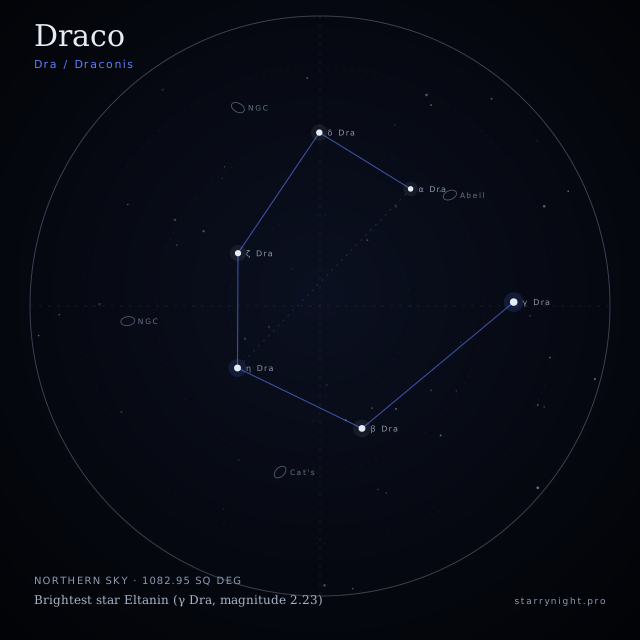
Draco spreads across 1,082.95 square degrees of sky, about 2.6 percent of the whole celestial sphere and enough to rank it among the ten largest of the 88 constellations. Size matters here: this is not a compact figure but a long, winding chain coiled around the north celestial pole, so its area buys sky rather than star density. Eltanin, γ Draconis, is the brightest star at magnitude 2.23, and its K5III classification marks it as a cool orange giant — a star that has already swollen off the main sequence. Nothing else in the constellation comes close: η Draconis at 2.73 is roughly 1.6 times fainter, and Rastaban at 2.79 fainter still. Five of the six catalogue stars carry luminosity class III, Rastaban a class II bright giant; even Thuban, the A0III blue-white at 3.65, outranks most of them in temperature while sitting last in brightness. The naming follows third-declension Latin: Draco in the nominative, Draconis in the genitive, abbreviated Dra — hence Bayer designations read γ Draconis, not γ Draco.
Star-hop to it
Draco rewards patience: it is circumpolar from 40°N and northward, wheeling around Polaris and never setting, though July evenings put it at its most convenient height. Start with the Big Dipper: the two stars at its bowl's outer edge point straight at Polaris, and Draco's tail threads the gap between the two bears. Thuban, α Draconis at 3.65, is the anchor — roughly midway between Mizar, in the Dipper's handle, and the bowl of the Little Dipper. From Thuban the body coils counter-clockwise around the pole toward a compact quadrilateral, the dragon's head. Vega, brilliant in Lyra to the east, is a useful cross-check; sweep northwest from it and you cross the head. The head's two brightest members are easy to separate: Eltanin at 2.23, an orange giant, and Rastaban at 2.79 beside it. Look for the Keystone of Hercules immediately south, since Draco's head almost touches it. South of 40°N the tail dips below the horizon and the dragon loses its coils.
Myth and culture
Draco is the dragon of the north, and Greek tradition gives it two overlapping identities. In one, it is Ladon, the hundred-headed serpent that guarded the golden apples of the Hesperides until Heracles killed it as his eleventh labour; Hera set the creature in the sky as a reward for its service. In the other, it is the dragon thrown down by Athena during the Gigantomachy and fixed among the stars, its head placed beneath the foot of Hercules. Arabic star names preserve a different reading of the same animal. Thuban, α Draconis, comes from thuʿbān, 'the serpent'; Eltanin and Rastaban both descend from raʾs al-tinnīn, 'the head of the dragon'; Aldhibah means 'the wolves', Altais 'the goat'. In the Chinese sky Draco's stars belong to the Purple Forbidden Enclosure around the pole, and Thuban itself served as the north pole star roughly 5,000 years ago, before precession carried the pole to Polaris. Because the constellation never sets from mid-northern latitudes, mythographers made it a sleepless guardian of the pole.
Deep-sky tour
Draco's deep-sky list is short but unusually well matched to small telescopes. The Cat's Eye Nebula, NGC 6543, is the showpiece: a planetary nebula at magnitude 8.1 whose high surface brightness matters more than its magnitude, since its light is packed into a tiny disc rather than smeared across arcminutes. A 60- or 80-mm refractor shows a blue-green dot, and the nebula takes magnification without fading, unlike the diffuse nebulae it superficially resembles. The Spindle Galaxy, NGC 5866, is a lenticular (S0) at magnitude 9.9, seen almost edge-on: a clean line of light with a brighter core and no spiral structure. It is commonly listed as M102, a disputed number. NGC 5907, the Splinter Galaxy, is a harder proposition — an edge-on Sc of magnitude 10.4 stretched 12 arcminutes long, so its light is spread thin, and it takes a large aperture under dark skies. Abell 2218 is a different matter: a galaxy cluster at magnitude 14, too faint for most amateur scopes, prized instead for its gravitational-lens arcs and therefore an imaging target only.
Catalogue data
| Latin name | Draco |
|---|---|
| IAU abbreviation | Dra |
| Genitive | Draconis |
| Sky zone | Northern sky |
| Best from | 40°N and northward |
| Best month | July |
| Area | 1082.95 square degrees |
| Brightest star | Eltanin (γ Dra, magnitude 2.23) |
Story & naming
This is Ladon, the hundred-headed dragon that guarded the golden apples of the Hesperides until Hercules killed it as his eleventh labour. Hera placed the dragon in the sky, where its coils wrap around the pole. Draco also carries a quiet historical claim: its star Thuban was the pole star when the Egyptian pyramids were built, roughly 4,700 years ago, and will be again in about 20,000 years.
How to find it
Trace the dragon from the middle of the Big Dipper's bowl: the faint stars of its tail start between Dubhe and Phecda. Follow the twisting body north and around the pole past the Little Dipper, then let it descend toward the bright quadrilateral of the head, which sits just north of Hercules. The head is the only part that stands out on a moonlit night.
Main stars
| Star | Designation | Magnitude | Spectral type |
|---|---|---|---|
| Eltanin | γ Dra | 2.23 | K5III |
| Rastaban | β Dra | 2.79 | G2II |
| Eta Draconis | η Dra | 2.73 | G8III |
| Aldhibah | ζ Dra | 3.17 | B6III |
| Altais | δ Dra | 3.07 | G9III |
| Thuban | α Dra | 3.65 | A0III |
Deep-sky objects
| Object | Type | Magnitude | Note |
|---|---|---|---|
| Cat's Eye Nebula (NGC 6543) | Planetary nebula | 8.1 | Bright and high surface brightness; a small scope shows a blue-green disc. |
| NGC 5866 Spindle Galaxy | Lenticular (S0) | 9.9 | A clean edge-on line of light, often listed as M102. |
| NGC 5907 Splinter Galaxy | Edge-on spiral (Sc) | 10.4 | A needle 12 arcminutes long for large apertures. |
| Abell 2218 | Galaxy cluster | 14 | Famous gravitational-lens arcs; imaging target only. |
Observing notes
The Cat's Eye Nebula is one of the few planetaries bright enough to survive city light; its blue-green tint is obvious in a 100 mm scope, though the concentric shells need much more. Thuban is a useful teaching star — point a telescope mount at the pole and drift is nearly zero. Look also for the faint galaxy NGC 5866, which some star atlases label M102.
Bordering constellations
- Ursa Minor
- Cepheus
- Cygnus
- Lyra
- Hercules
- Bootes
- Ursa Major
- Camelopardalis
Note
StarryNight is an informational reference for amateur observers. Nothing here is professional astronomical, navigational or safety advice — always check a current almanac and your local weather before travelling to a dark site.
The same sheet in the other language: 天龙座 Draco