Northern sky · UMi
Ursa Minor, the Little Bear
Ursa Minor · Ursae Minoris
Ursa Minor is a small, faint bear whose tail ends at Polaris. It is the constellation that does not move: the whole sky pivots around it while everything else wheels past.
Physical profile
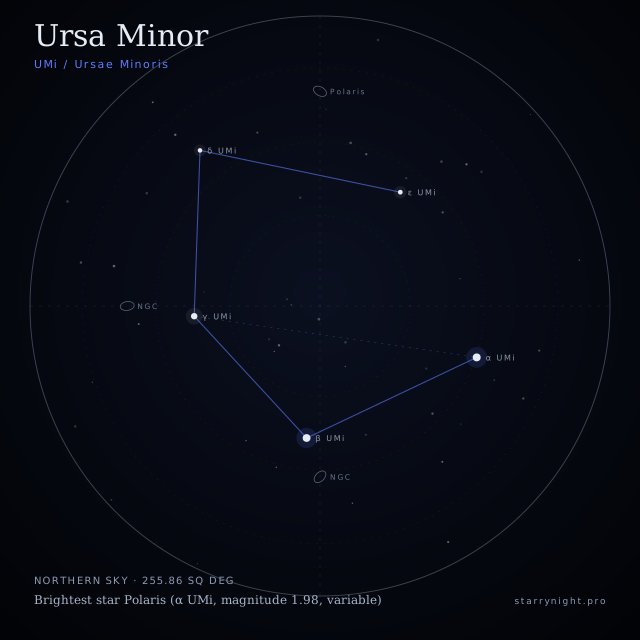
Ursa Minor covers 255.86 square degrees, a modest patch among the 88 constellations. That figure places it in the sky’s middle rank—large enough to contain a whole dipper pattern, small enough that its boundaries never sprawl. The catalogue gives no distance, so these numbers describe apparent scale and light, not true physical size. Its brightest star, Polaris, shines at magnitude 1.98 and is flagged variable; the spectral type F7Ib identifies a yellow supergiant, and the Cepheid label means it pulsates, though the catalogue gives no period or amplitude here. Kochab, at magnitude 2.08 and type K4III, is an orange giant, while Pherkad (3.05, A3II-III) is a white luminous giant. Yildun (4.35, A1Vn) and Epsilon Ursae Minoris (4.21, G5III) are far fainter. The Latin name is Ursa Minor, “Lesser Bear”; its genitive, Ursae Minoris, governs Bayer designations such as α Ursae Minoris. That genitive is why the brightest star is Alpha Ursae Minoris, not Alpha Ursa Minor.
Star-hop to it
Because Ursa Minor sits north of about 10°N, its entire pattern stays above the horizon for observers at those latitudes, so June is less a first chance than a good month for a clear evening view. Start with Draco, which coils between the Big Dipper and Polaris. Follow Draco’s body northward until the two brightest stars of the Little Dipper’s bowl appear: Kochab and Pherkad, the Guardians of the Pole. From Cepheus, draw an imaginary line from Alderamin through Errai; it carries the eye toward Polaris. Camelopardalis is faint and offers no bright anchor, so treat it as the dark gap east of Polaris rather than a signpost. Once Polaris is found, the rest of the constellation hangs southward from it: Yildun lies near the pole, then Epsilon, then the bowl stars Kochab and Pherkad. A small scope resolves Polaris’s wide companion, 18 arcseconds away, but that is a telescopic target, not a naked-eye hop.
Myth and culture
Ursa Minor is the Lesser Bear, the smaller companion to the great bear Ursa Major. In one Greek telling, Zeus turned Callisto into a bear and her son Arcas into another to save them; the pair became the two bears, though versions differ and Arcas is sometimes placed in Boötes. The constellation’s older name, Cynosura, means “dog’s tail,” and that word became a byword for the pole star itself. Arabic tradition left clearer marks on the star names. Kochab comes from al-kawkab, “the star,” while Kochab and Pherkad together are al-farqadān, “the two calves,” also called the Guardians of the Pole. Yildun likely traces to a word for “star.” In Chinese astronomy, Polaris belongs to the circumpolar Purple Forbidden Enclosure, tied to the emperor and the fixed pivot of heaven; it is known as 勾陈一 or 北极星. The same point of light, read as bear, dog’s tail, calf, or imperial pivot, shows how differently cultures mapped the north.
Deep-sky tour
Ursa Minor holds two listed galaxies, and neither is a showpiece. NGC 6217 is a barred spiral of type SBbc at magnitude 11.2; its total light is spread thinly, so a 200 mm scope under dark skies shows mainly the core, with the distinct bar emerging only with averted vision and steady seeing. NGC 6251 is an elliptical/radio galaxy at magnitude 12.2. Its famous jet stretches thousands of light-years, but that structure is invisible visually; through a small telescope the galaxy is a faint, small smudge, and even large apertures need dark transparent skies. The third target is Polaris itself, magnitude 1.98. Its F7Ib supergiant and Cepheid nature belong to the star, not the field, but the wide optical companion 18 arcseconds away is easy in a small scope. Use high power to split it cleanly, and note that the companion is not physically tied to Polaris.
Catalogue data
| Latin name | Ursa Minor |
|---|---|
| IAU abbreviation | UMi |
| Genitive | Ursae Minoris |
| Sky zone | Northern sky |
| Best from | Any latitude north of about 10°N |
| Best month | June |
| Area | 255.86 square degrees |
| Brightest star | Polaris (α UMi, magnitude 1.98, variable) |
Story & naming
The Little Bear was usually identified as Arcas, son of Callisto, or in some versions as the Phoenician navigator who first steered by the pole star. Its Greek name Kynosoura — "the dog's tail" — survives in the Latin word Cynosura, an old poetic name for the pole star. The two stars at the far end of the bowl, Kochab and Pherkad, were the "Guardians of the Pole" in Arab astronomy because they circled close to the pole before precession carried that honour to Polaris.
How to find it
First find the Big Dipper, then extend the line from Merak through Dubhe about five times their separation. Polaris is the lone bright star at the end of that line, and it is also the last star in the handle of the Little Dipper. From Polaris, the bowl opens away from the Big Dipper toward Kochab. On hazy nights the three fainter handle stars vanish first, leaving only a naked pair against the sky.
Main stars
| Star | Designation | Magnitude | Spectral type |
|---|---|---|---|
| Polaris | α UMi | 1.98 | F7Ib (Cepheid) |
| Kochab | β UMi | 2.08 | K4III |
| Pherkad | γ UMi | 3.05 | A3II-III |
| Yildun | δ UMi | 4.35 | A1Vn |
| Epsilon Ursae Minoris | ε UMi | 4.21 | G5III |
Deep-sky objects
| Object | Type | Magnitude | Note |
|---|---|---|---|
| NGC 6217 | Barred spiral galaxy (SBbc) | 11.2 | Small but with a distinct bar; a 200 mm scope under dark skies shows the core. |
| NGC 6251 | Elliptical / radio galaxy | 12.2 | Famous for a jet thousands of light-years long, invisible visually. |
| Polaris itself | Yellow supergiant + Cepheid | 1.98 | A wide optical companion sits 18 arcseconds away and is easy in a small scope. |
Observing notes
Measure your latitude directly: the altitude of Polaris above the horizon, in degrees, equals your latitude within about a degree. It is also a fine Cepheid — a small telescope and a few evenings of magnitude estimates will show the 3.97-day pulsation. Because the field barely rotates, this is the place to leave a camera tracking mount unguided for wide star trails.
Bordering constellations
Note
StarryNight is an informational reference for amateur observers. Nothing here is professional astronomical, navigational or safety advice — always check a current almanac and your local weather before travelling to a dark site.
The same sheet in the other language: 小熊座 Ursa Minor